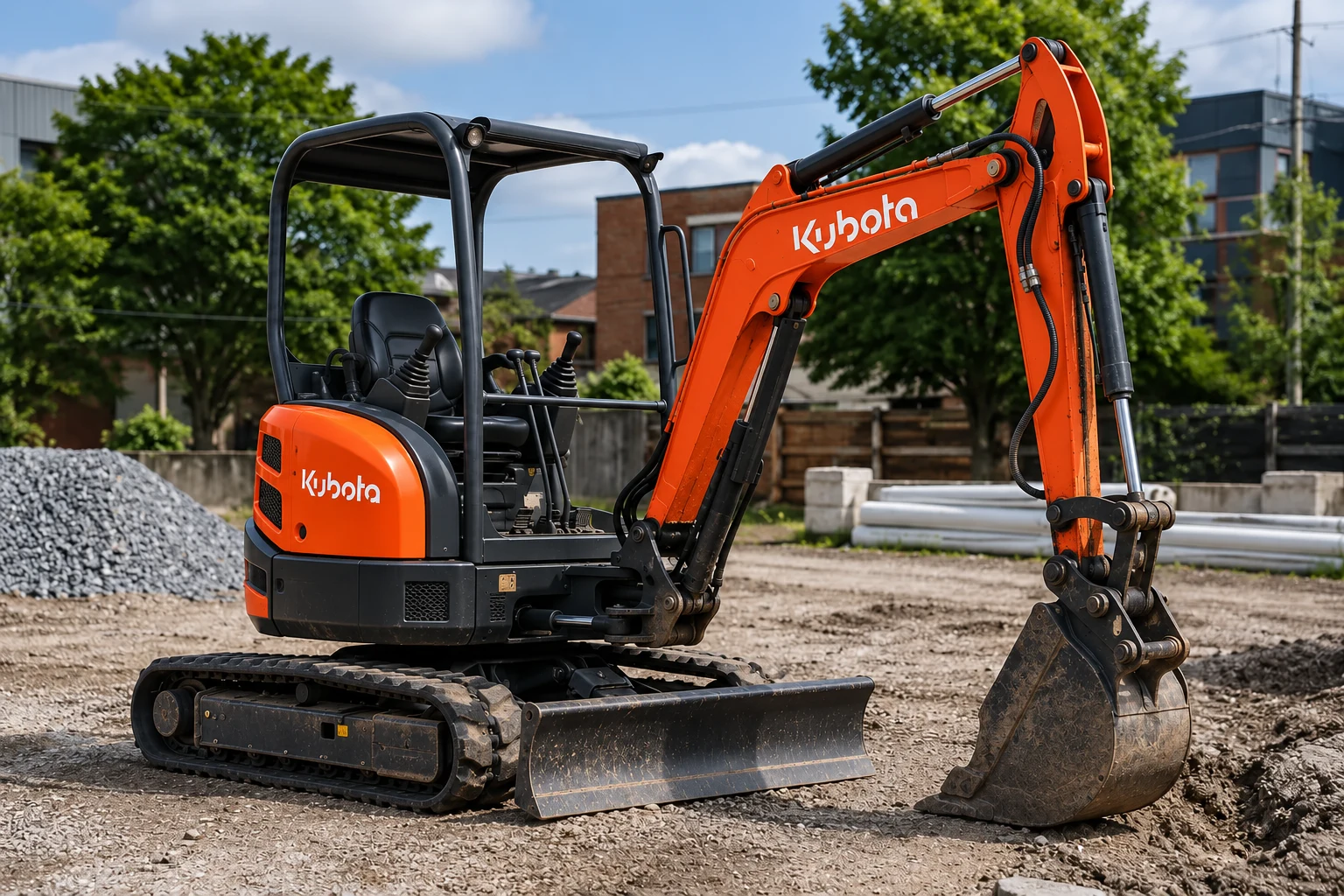
Measure the narrowest part of the job
Record gate width, overhead clearance, turning space and the route from unloading to work. Check whether the quoted width refers to retracted or extended tracks. An access configuration is not automatically the configuration used for working ratings. Include protruding attachments and the space needed for the upper structure and digging equipment to move.
Choose the arm and tool package
Compare the installed arm, bucket, coupler and auxiliary circuits. A longer arm can change the work envelope and the relevant lifting configuration; it should not be evaluated only as additional digging depth. If a breaker or auger is central to the business, ask its supplier to verify flow, pressure, return and mounting requirements against the actual machine.
Inspect compact-machine wear points
Request assessment of tracks, sprockets, rollers, final drives, boom swing, blade pivots and digging linkage. Ask whether tight access has led to body, guard or hose damage. Have a competent operator demonstrate travel and fitted functions under agreed conditions. Verify that any cab, canopy or track arrangement matches the source record used to interpret specifications.
Check the complete transport package
Use actual travel weight and dimensions with the bucket, coupler, fuel and carried tools. Give those inputs to the transport provider or the person assessing your towing combination. A weight-class nickname is not a payload figure. Include the cost and practicality of separate attachments, loading and storage when comparing machines for frequent short jobs.
Decision worksheet
| Decision | Evidence to collect | How it changes the shortlist |
|---|---|---|
| Access | Measured route and track position | Checks entry and operating clearance |
| Tools | Installed circuits and mounting details | Confirms that the main revenue task is supported |
| Mobilization | Actual machine and tool package | Tests whether frequent moves are practical |
Before you decide
Questions to close out
- Measure the entire access route.
- Verify track position and arm configuration.
- Inspect swing-post and blade linkage.
- Confirm the fully loaded transport arrangement.
Choose the smallest package that can reliably complete the defined task, with the required clearances and attachments. Small dimensions alone do not establish lifting suitability.
Continue your research
Sources and further reading
Technical references supporting this guide. Machine manuals and documentation for the actual configuration remain essential when applying the guidance.