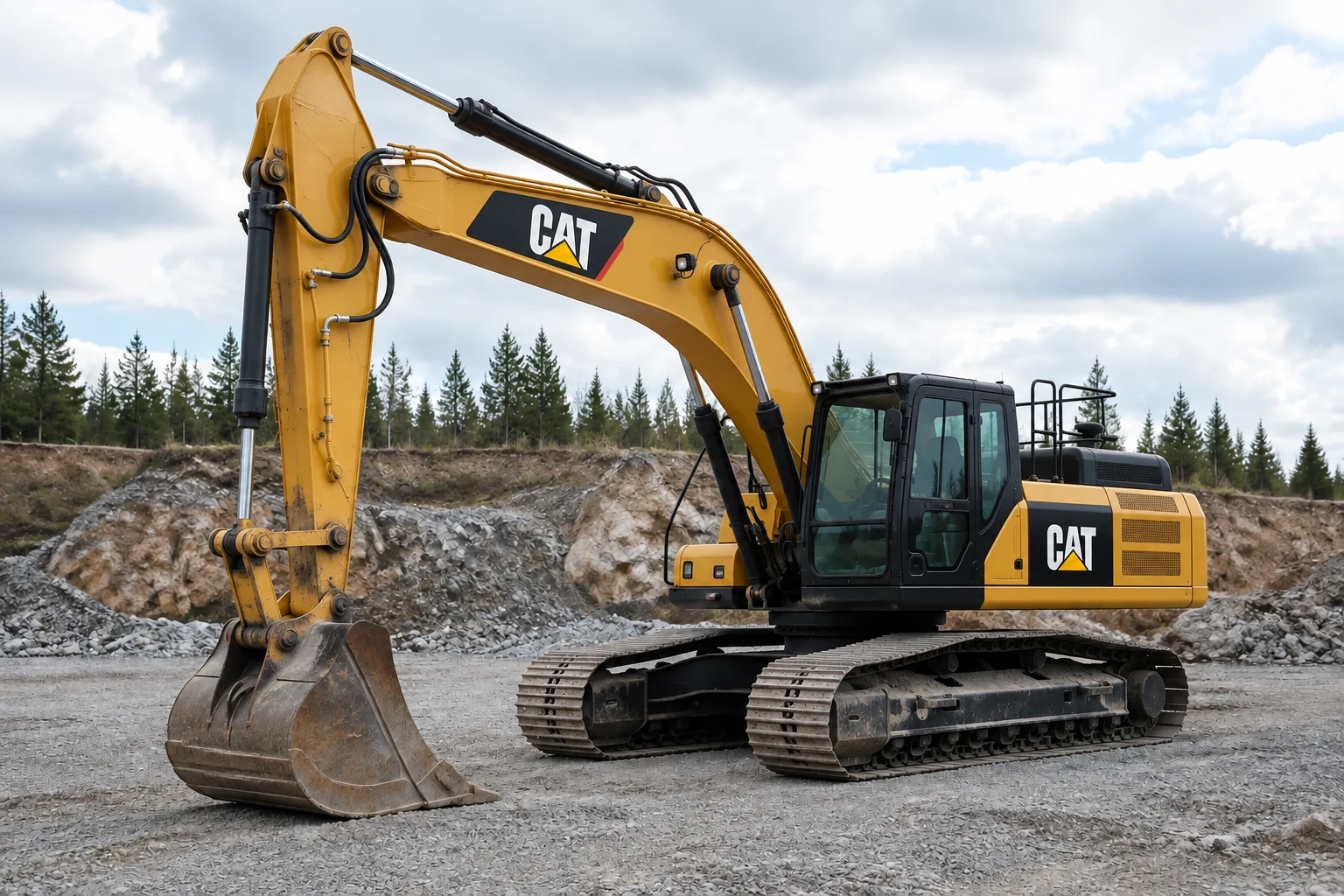
Turn the job into a machine brief
Write down the trench depth, required reach from a realistic setup position, loading target, ground conditions and access width. Include the bucket, coupler and any breaker or grapple. Separate ordinary excavation from lifting: a digging-depth figure does not establish an allowable suspended load. Use the exact lift chart for the intended setup with a qualified operator.
Match the reference configuration
Record the complete model designation and serial/PIN. Identify boom and arm length, track shoes, cab, counterweight and attachment. A brochure may describe several arrangements with different weight and working envelopes. Photograph those fitted components and compare them with the configuration beside each HeavyEQ value. Treat an unresolved match as a question for the seller or manufacturer, not as an average of two tables.
Inspect systems that can change the deal
Commission an undercarriage measurement report and inspect linkage, cylinders, slew structure and travel systems. Ask the inspector to record the test conditions and limitations. A brief video of an unloaded bucket cycle is not equivalent to a controlled functional inspection. Operators should perform demonstrations in a suitable exclusion area; buyers should remain clear of moving equipment and unsupported raised components.
Compare the delivered, usable package
List the repairs needed before work, attachment changes, transport, loading and initial service. Ask what is included in the sale: a displayed coupler, bucket or grade-control receiver may be separately priced. Compare two machines after bringing them to the same working specification. A documented repair may reduce uncertainty; it does not reset the age of unrelated components.
Decision worksheet
| Decision | Evidence to collect | How it changes the shortlist |
|---|---|---|
| Reach and access | Work envelope, gate width and setup location | Reject machines that cannot complete the actual task |
| Undercarriage | Measured wear and itemized quote | Budget a system repair rather than cosmetic track appearance |
| Attachment package | Included tools and hydraulic specification | Price missing hoses, controls, coupler and installation |
Before you decide
Questions to close out
- Record the serial/PIN and configuration photographs.
- Request cold-start, diagnostic and service evidence.
- Obtain independent condition and transport quotes.
- Document included attachments before agreeing a price.
A useful shortlist contains machines that can do the same job in their actual configuration. Only then do hours, price and repair exposure become a meaningful comparison.
Continue your research
Sources and further reading
Technical references supporting this guide. Machine manuals and documentation for the actual configuration remain essential when applying the guidance.