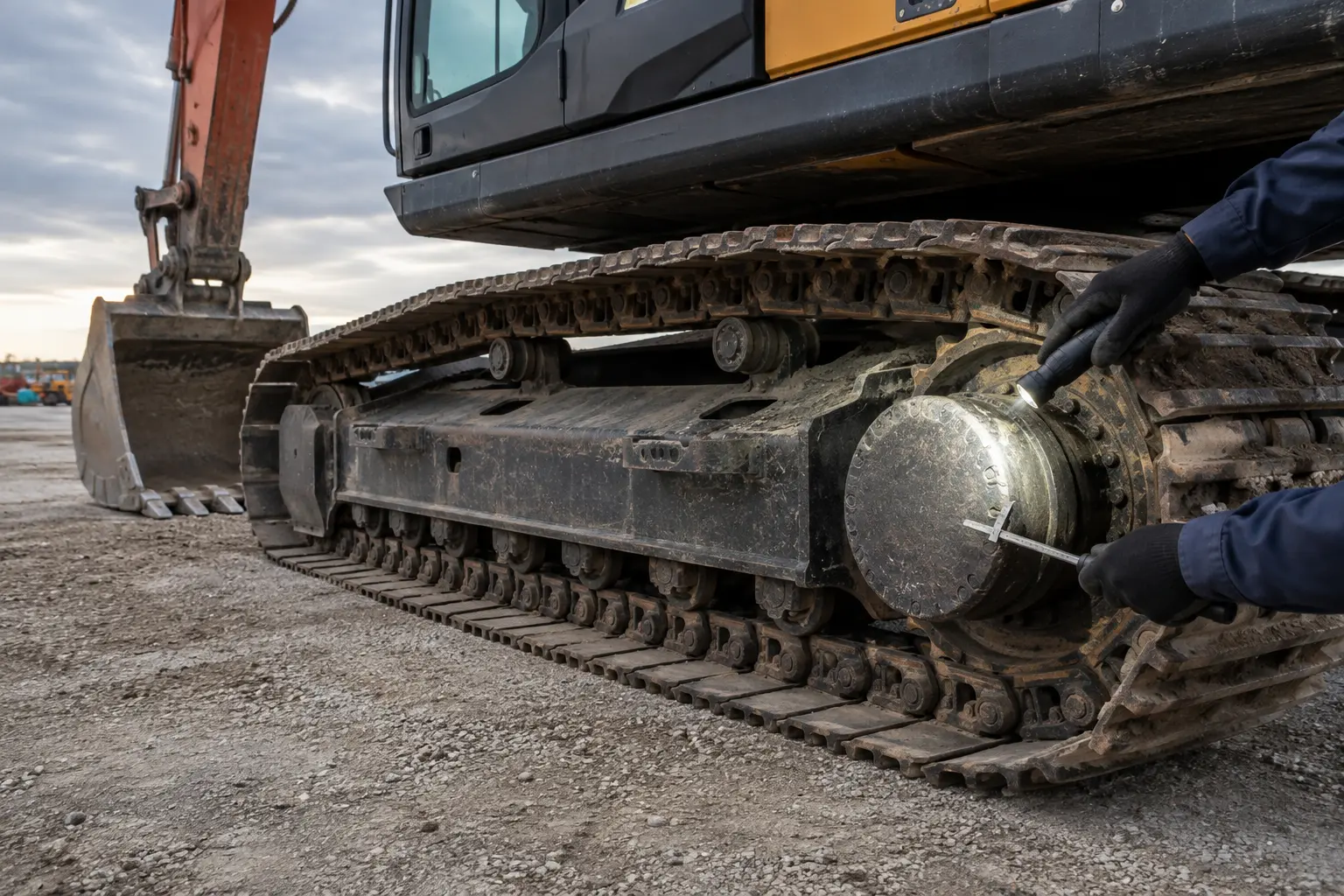
Identify the carrier and the tool
Record both serial/model identities and the installed carrier configuration. Ask for the attachment manual, mounting arrangement and required circuits. An attachment listing may show several bracket or motor options, so confirm the exact unit being sold. Keep any adapter, coupler or tiltrotator in the assessment; every added component can change the combined package.
Verify the mechanical connection
Use the manufacturer's interface information and a qualified supplier to confirm mounting dimensions, locking arrangements and attachment weight. For pin-mounted tools, obtain the relevant pin and linkage dimensions rather than assuming fit from machine weight class. For forks or lifting tools, confirm the applicable capacity and load basis. Physical engagement alone does not establish an approved lifting arrangement.
Match every hydraulic and control requirement
Compare required flow, pressure, return routing, allowable back pressure, case drain and electrical controls as applicable. Bobcat's hydraulic guidance explains why loader and attachment packages must be matched. Do not treat maximum pump flow as guaranteed flow at an auxiliary connection under all conditions. Have a qualified technician verify the installed circuit when records are incomplete.
Budget commissioning and transport
Include hoses, connectors, controls, mounting work, setup and any required confirmation from the supplier. Check operating clearance and how the combined package travels. Ask who will demonstrate the attachment after installation and what documentation will be supplied. Keep compatibility confirmation with the machine record so a later operator or buyer can identify the accepted configuration.
Decision worksheet
| Decision | Evidence to collect | How it changes the shortlist |
|---|---|---|
| Mechanical interface | Exact mount and locking-system details | Confirms the intended connection |
| Hydraulic circuit | Flow, pressure, return and drain requirements | Identifies missing circuits or commissioning work |
| Combined package | Weight, clearance, controls and duty approval | Checks usefulness beyond physical fit |
Before you decide
Questions to close out
- Identify carrier, attachment and adapters.
- Obtain written hydraulic requirements.
- Confirm controls and circuit configuration.
- Arrange a supplier-supported demonstration.
Use a compatibility checklist as a request for evidence. It should never convert a similar-looking attachment into a confirmed fit without the necessary manufacturer or supplier information.
Continue your research
Sources and further reading
Technical references supporting this guide. Machine manuals and documentation for the actual configuration remain essential when applying the guidance.