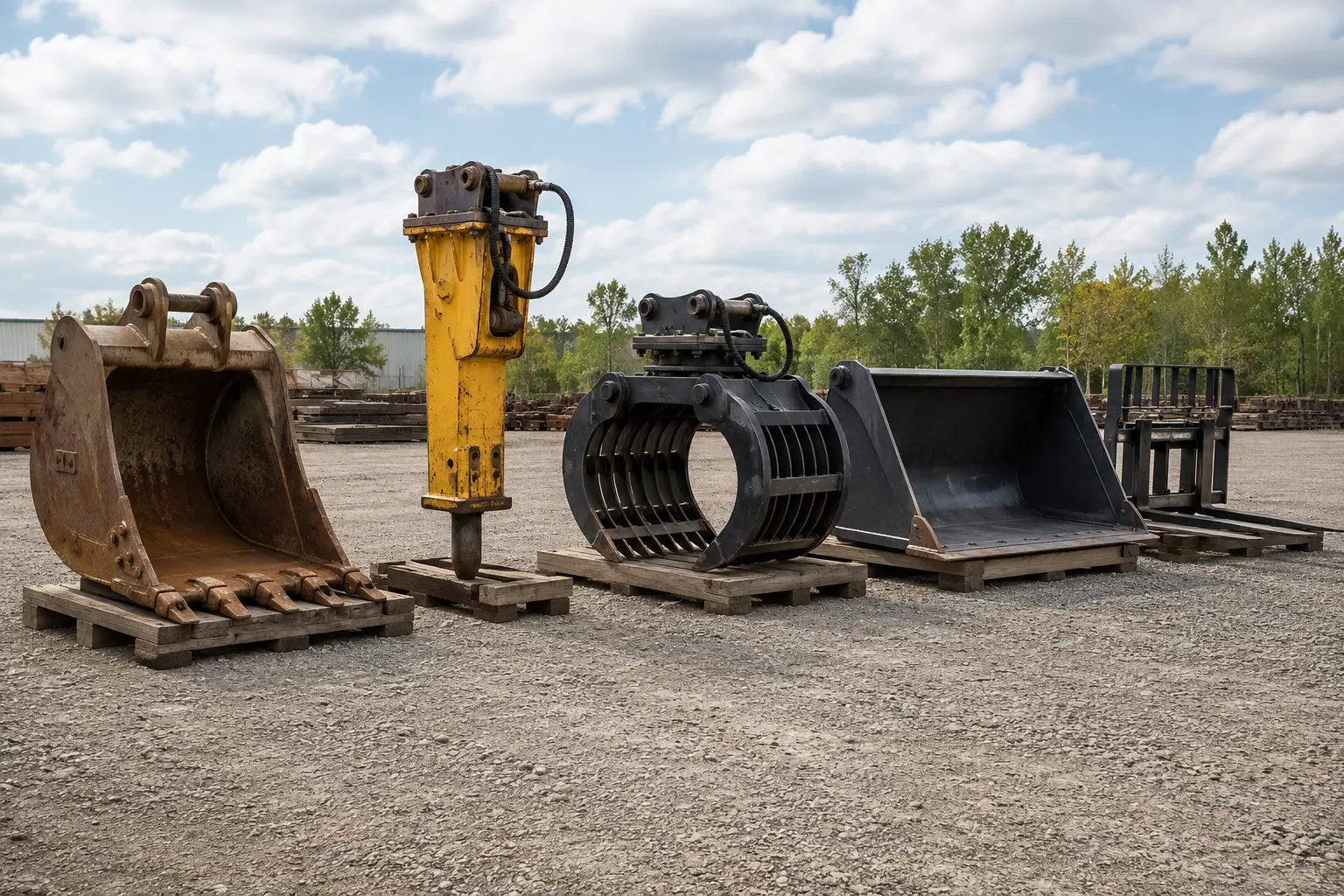
Make a list of the buckets and powered tools that must stay in service. Record their pickup geometry and the intended carrier. Compare a dedicated attachment system with a pin-grabber arrangement using the manufacturer’s compatibility information; neither name guarantees that every existing tool can be carried over.
Compare the complete installed package
Include the coupler, hoses, controls and any tilt function. Ask which machine and attachment combinations are specifically supported, and whether a special arm arrangement changes the permitted choice. A convenient changeover system is only useful if the complete package matches the work and the carrier.
Review locking and inspection requirements
Obtain the manual for the exact coupler and a record of its maintenance. Have the pickup points, locking parts and hydraulic installation inspected. Require a competent demonstration using the manufacturer’s attachment-change and retention-check procedures; this buying guide does not replace those procedures.
Build the attachment purchase brief
Decision
Evidence to obtain
How to use it
Existing attachment fleet
Pickup drawings and attachment IDs
Establish which tools can genuinely transfer
Machine and arm
PIN and installed arm/coupler arrangement
Check the manufacturer’s supported combinations
Installed condition
Locking-system assessment and fitting quote
Include repair, plumbing and control costs
Compatibility factors to verify
Information required
Pickup drawings and attachment IDs
PIN and installed arm/coupler arrangement
Locking-system assessment and fitting quote
Fitment and operating checks
Carrier machine class and serial-specific configuration
Attachment weight, centre of gravity and machine stability
Pin geometry, ear width or exact coupler interface
Hydraulic flow, pressure, return line and case drain where applicable
Auxiliary electrical controls and manufacturer restrictions
Final fitment, stability, hydraulic performance and safe operating limits must be confirmed through applicable manufacturer guidance, a dealer or a qualified attachment supplier.
Related verified model research
A short class-level research path—not an exact-fitment list.
Select a researched model and attachment class to expose what is known and what still needs verification.
No selection in this checker is an attachment approval. Unknown fitment remains unknown.
Technical research & specification evidence
Mechanical pin-grabbers and wedge couplers: identify the retention architecture
Original identification research and qualified issuer references. Actual installed assemblies, serial-specific fitment and safety approval remain unverified.
Mechanical coupler is a category, not a complete design description. A research record needs the actual pickup geometry, moving retention member, independent safety provision and attachment interface. The aim is to distinguish assemblies accurately without converting a visual resemblance or a working latch into an approval.
Mechanical quick couplerMechanical quick-coupler family illustration; actual locking design, safe operating procedure, compliance and fitment require manufacturer verification.
Component family researchInstalled fitment not established
Each reference retains its own subject and conditions. A series, model or family name does not establish an installed component, safe setting or interchangeable replacement.
Documented reference
Specifications with configuration evidence
Expand each row before comparing values. Examples, standards metadata and architecture observations retain their original scope.
Takeuchi US TB260 attachment configurator
Mechanical pin-grabbers and wedge couplers: identify the retention architecture: Takeuchi US TB260 attachment configurator
Parameter
Reference value
Evidence
TB260 manufacturer configuration alternatives
Mechanical quick coupler; hydraulic pin-grabber choicesTakeuchi US TB260 configurator as reviewed
Scope & source
Coexisting catalogue configuration choices only; actual installed arrangement unknown
Reference: Takeuchi US TB260 configurator as reviewed
Current first-party manufacturer product reference · Descriptive classification; no dimensional datum · Manufacturer reference only; no machine/PIN, installed condition, certification or operating approval established
Choose Attachments: Quick Coupler (Mechanical), and Hydraulic Pin Grabber Coupler groups
Web reference checked 2026-10-15; numbered manufacturer revision not stated
No machine-specific, installed or serial-verified fitment established.
Source checked 2026-10-15. PUBLIC_REFERENCE_ONLY; no catalogue, manual, media or table reuse licence supplied
Open identification fields (4)
These values have not been established. Unknown, unavailable, unverified and not applicable remain distinct evidence states; none means zero.
Mechanical pin-grabbers and wedge couplers: identify the retention architecture: unresolved identification requirements
Parameter
Evidence state
Required scope
Mechanical retention design
Unverified
Issuer-designated primary and secondary retention architecture
Attachment pickup geometry
Unverified
Exact mating pin or hanger geometry with dimensions and datum
Safety documentation revision
Unverified
Applicable declaration and instructions for identified coupler
Installed coupler identity
Unverified
Maker, raw assembly code and revision observed on the actual machine
Separate interface from actuation
Describe what the coupler accepts before describing how it moves. A pin-grabber references attachment pins; another coupler may engage a dedicated hanger or wedge interface. Mechanical actuation describes the means used to move a locking element, not the full geometry of the connection. Record the maker, series, version and identification plate, then name the attachment-side interface in the issuer's own terminology. Avoid treating wedge, pin-lock and pin-grabber as interchangeable search labels.
Manufacturer choices can coexist on one model
Takeuchi's current US TB260 configurator lists a mechanical quick coupler separately from hydraulic pin-grabber choices and separates their associated bucket groups. That supports a model-level configuration distinction, not proof of the coupler fitted to a particular TB260. An equipment name can therefore narrow the research context while leaving the assembly unresolved. A used coupler offered without its plate or configuration history needs further evidence rather than a guessed option code.
Record the parts that establish retention
For identification, request a description of the primary retention member, secondary retention provision, indicator arrangement and any captive hardware. Keep these as separate questions because one photograph may conceal a different mechanism behind a familiar shell. Record whether a supplied component is the complete coupler, a locking subassembly or only an attachment hanger. A visibly present safety device is not evidence of condition or conformance. Do not produce a generic locking sequence for an unidentified design.
Define geometry without creating an interchange chart
A useful dimensional worksheet identifies pickup-pin diameters, centre-spacing range where documented, attachment bearing widths and clearance envelope. Each value needs the exact coupler version and source datum. A range printed for a series does not establish every combination within it, nor does it resolve locking engagement or tool clearance. Record measurements as observations alongside their method and date. Preserve any conflict with manufacturer drawings for review; never resolve it by selecting whichever value makes the proposed attachment appear suitable.
Used-assembly evidence should be traceable
Request documented use history, inspection records, replacement-lock history and evidence of structural alterations. Separate ordinary surface condition from an engineering judgement about deformation, cracking or retention wear. Photographs can help classify missing or mismatched components but cannot establish a safe remaining life. Repair history should identify who authorized the work and which applicable documentation was used. This article supplies a record framework, not acceptance limits, adjustment instructions or a conversion from mechanical to hydraulic actuation.
Decide what the evidence actually supports
An article may explain a coupler family while retaining unknown installed dimensions and approval. An exact replacement inquiry needs a legitimate issuer record linking the specific coupler version, attachment interface and carrier arrangement. Keep any claim that a system meets a standard attributed to its maker until the appropriate declaration and configuration are available. ISO quick-coupler metadata identifies a reference document; it does not certify the assembly. Retention or engagement uncertainties belong in a technical hold, not in a substitute field procedure.
Unresolved technical and source questions (2)
No exact coupler code, locking condition, adjustment criterion or machine approval established.
Wedgelock FAQ numeric tilt sentence is inconsistent; restrictive site terms kept as a private source hold; no public reuse of that material.
Officially linked JSONLines dataset, retained records id67669 and83132 only; see work/parts02d-iso-open-metadata.json for exact dates, stages, dataset hash and acquisition time
ODC-By1.0 metadata with ISO attribution; no standards clauses, text, test method or certificate acquired
Original HeavyEQ analysis and selected source facts. No catalogue reproduction licence, manufacturer endorsement or machine-specific compatibility is implied.
Hydraulic quick couplers: mechanical retention and hydraulic actuation need separate evidence
Original identification research and qualified issuer references. Actual installed assemblies, serial-specific fitment and safety approval remain unverified.
A hydraulic quick coupler combines a load-bearing mechanical connection with an actuation system. Research must resolve those layers independently. A hose connection, cab indicator or product-family name cannot establish the condition of the lock or the approval of a particular carrier and attachment combination.
Hydraulic quick-coupler body and lockOne open-frame hydraulic-quick-coupler embodiment with a visible hook,pivot-shaped latch and short actuator. No validated lock state,safety mechanism,pressure,load capacity,pin range or exact fit;not an operating instruction. HeavyEQ family research illustration; installed fitment is not established.
Component family researchInstalled fitment not established
Each reference retains its own subject and conditions. A series, model or family name does not establish an installed component, safe setting or interchangeable replacement.
Documented reference
Specifications with configuration evidence
Expand each row before comparing values. Examples, standards metadata and architecture observations retain their original scope.
Volvo CE Canada excavator quick couplers
Hydraulic quick couplers: mechanical retention and hydraulic actuation need separate evidence: Volvo CE Canada excavator quick couplers
Parameter
Reference value
Evidence
Volvo S-type catalogue interface wording
S1, S2 or S3 onlyVolvo CE Canada S-type quick-coupler family, not the separate Steelwrist S60/S70 family
Scope & source
Published interface designations; no equivalence between sizes or installed fitment
Reference: Volvo CE Canada S-type quick-coupler family, not the separate Steelwrist S60/S70 family
Current first-party manufacturer product reference · Descriptive classification; no dimensional datum · Manufacturer reference only; no machine/PIN, installed condition, certification or operating approval established
Categories and filters: S-type quick coupler snippet
Web reference checked 2026-10-15; numbered manufacturer revision not stated
No machine-specific, installed or serial-verified fitment established.
Source checked 2026-10-15. PUBLIC_REFERENCE_ONLY; no catalogue, manual, media or table reuse licence supplied
Volvo CE US universal quick coupler with Front-Pin Lock
Hydraulic quick couplers: mechanical retention and hydraulic actuation need separate evidence: Volvo CE US universal quick coupler with Front-Pin Lock
Parameter
Reference value
Evidence
Volvo universal pin-grabber design statement
Front pin lock technologyVolvo CE US universal hydraulic pin-grabber family as reviewed
Scope & source
Manufacturer-described safety-design feature only; no independent test, conformance or exact pair approved
Reference: Volvo CE US universal hydraulic pin-grabber family as reviewed
Current first-party manufacturer product reference · Descriptive classification; no dimensional datum · Manufacturer reference only; no machine/PIN, installed condition, certification or operating approval established
Opening paragraph: Front pin lock technology; range qualifier for other-maker attachment pickup
Web reference checked 2026-10-15; numbered manufacturer revision not stated
No machine-specific, installed or serial-verified fitment established.
Source checked 2026-10-15. PUBLIC_REFERENCE_ONLY; no catalogue, manual, media or table reuse licence supplied
Open identification fields (4)
These values have not been established. Unknown, unavailable, unverified and not applicable remain distinct evidence states; none means zero.
Hydraulic quick couplers: mechanical retention and hydraulic actuation need separate evidence: unresolved identification requirements
Parameter
Evidence state
Required scope
Exact hydraulic lock assembly
Unverified
Issuer code and revision for the installed retention and actuation assembly
Lock circuit requirement
UnverifiedRequested unit: bar
Applicable function-specific hydraulic limits; not tool auxiliary pressure
Secondary retention evidence
Unverified
Exact design and supporting legitimate conformity documentation
Carrier and attachment approval
Unverified
Documented approved combination including installed configuration
Give the coupler its own identity
Start with the coupler issuer, assembly number, revision and installed orientation. Keep the machine-side connection separate from the lower attachment interface. A carrier may have changed buckets or couplers during its service life, so a factory equipment list and a current installed observation can both be true while describing different arrangements. Record the date and scope of each source. Do not make an installation claim from a machine model name or a photograph of an apparently similar coupler.
S-type names are scoped interface descriptions
Volvo CE Canada lists an S-type family described as matching S1, S2 or S3 attachment interfaces only. The same category separately lists a Steelwrist symmetrical family for S60 or S70 and a universal option with Front-Pin Lock. These are distinct catalogue descriptions. They do not establish S1 equals S2, nor that every S-labelled attachment mates with every S-type coupler. Retain the precise interface designation and issuer reference rather than reducing all of them to a single S-coupler tag. The current US Front-Pin Lock reference describes a hydraulic universal pin-grabber, with other-maker pickup conditional on the coupler's range. That conditional wording is preserved, without asserting a particular attachment pairing.
Do not collapse retention into its control circuit
Document primary retention, independent safety provision and any indication system as different objects. Hydraulic actuation may move a locking member, while mechanical design determines the retained interface. Control wiring and sensors belong to the existing electrical safety owner; valves, hoses and cylinders remain with hydraulic research. A complete technical inquiry asks for the legitimate assembly-specific documentation connecting those objects. It should not offer a generic way to defeat an indicator, override a lock or substitute another machine's hydraulic arrangement.
Name pressure and flow by function
If a source supplies hydraulic requirements, identify whether they concern lock actuation, the attached tool, a tiltrotator function or a separate auxiliary passage. Keep supply limits, required flow, return conditions and any electrical requirements in separately scoped fields. A maximum-pressure value for one function cannot authorize another circuit. No universal setting is assigned here. Missing configuration or conflicting source values should result in blank fields and a precise acquisition request for the applicable revision.
Treat a standard reference as a reference
Licensed ISO Open Data identifies ISO 13031:2016 and its Amendment 1:2025 as separate bibliographic records. That establishes neither a test result nor compliance of a used coupler. A technical file needs the manufacturer's declaration, applicable product configuration and legitimate instructions, with regional requirements considered by the responsible party. The date of a reference document cannot establish that every previously built machine contains a later safety revision. No standard clauses or inspection thresholds are reproduced.
Make the hold useful to the next reviewer
An unresolved record should name exactly which evidence is absent: coupler plate, attachment hanger drawing, safety revision, circuit arrangement, installation approval or condition assessment. This allows unrelated family research to remain useful while an exact fitment remains open. For a used assembly, preserve modification history and the scope of any prior inspection. Only documented issuer relationships can support a replacement edge. A hydraulic function observed in isolation does not justify a load rating, retrofit recommendation or return-to-service statement.
Quick-coupler standard references and the boundary of approval
ISO Open Data identifies ISO 13031:2016, edition 1, published 2016-05-02, and ISO 13031:2016/Amd 1:2025, edition 1, published 2025-02-07. These are bibliographic metadata references. They do not establish that an individual coupler, its lock, a carrier installation or a control arrangement meets the standard. The standards text and test clauses are not reproduced. Exact applicable documents and qualified configuration review remain necessary for any conformity decision.
Four separate rows in a coupler interface matrix
A coupler inquiry needs four interface rows rather than one machine-size label. The carrier-side row identifies the mount, linkage and clearance envelope. The attachment-side row identifies the two pickup positions, their diameters, centre spacing and width. The retention row identifies the complete locking arrangement and its controls. The load-and-stability row identifies the approved machine and attachment combination. Evidence that fills one row cannot silently fill another: a familiar pin diameter is not an approved lock system, and a lock indicator is not the machine stability record.
Variable pickup still requires an exact configuration
A published pickup range describes a mechanism capability within a named configuration. For a particular attachment, retain the actual front and rear pickup geometry and ask for the correct configured coupler drawing. Record any calipers, spacers or other pickup hardware separately from the base casting. Keep the machine generation and the coupler issue or modification state as independent identification fields. Existing Volvo universal pin-grabber research describes front-pin-lock technology at family level; it does not approve an unidentified modified coupler or establish a particular attachment pair.
Keep the drawing and the approval questions distinct
A dimensioned drawing can resolve an interface while leaving condition, control configuration or load approval open. A product overview can identify retention functions while leaving the exact assembly and inspection result unknown. Ask which issued document closes each uncertainty. Do not derive a safe working load from a lifting-eye shape or equate a marketed carrier tonnage range with approval for every machine in that range. The independently written matrix extends the existing research without importing a restricted vendor catalogue. Exact retention components, operating instructions, lock checks and lifting approval remain questions for the applicable controlled documentation and qualified professionals.
Unresolved technical and source questions (2)
Dedicated Volvo S-type product page failed; current category snippet is the accepted narrow wording locator.
No safety certification, locking operation, circuit setting or serial-specific approval established.
Officially linked JSONLines dataset, retained records id67669 and83132 only; see work/parts02d-iso-open-metadata.json for exact dates, stages, dataset hash and acquisition time
ODC-By1.0 metadata with ISO attribution; no standards clauses, text, test method or certificate acquired
Opening paragraph: hydraulic universal pin-grabber and Front pin lock technology; other-maker attachment pickup conditional on being within coupler range. No whole model grid or operating directions retained.
PUBLIC_REFERENCE_ONLY; no catalogue, manual, media or table reuse licence supplied
Selected dataset records67669 and83132; titles, editions and publication dates only; raw stage codes are not interpreted as approval
This work is based on the iso_deliverables_metadata dataset from ISO Open Data, licensed under ODC Attribution License (ODC-By) v1.0. Licence: https://opendatacommons.org/licenses/by/1-0/
Original HeavyEQ analysis and selected source facts. No catalogue reproduction licence, manufacturer endorsement or machine-specific compatibility is implied.
Automatic multi-couplers: keep mechanical, hydraulic and electrical connections distinct
Original identification research and qualified issuer references. Actual installed assemblies, serial-specific fitment and safety approval remain unverified.
Automatic attachment connection joins several interfaces in one assembly. The research record should preserve each one: mechanical retention, fluid passages, optional electrical contacts and the tool functions carried through them. An automatic connection claim is useful only when its exact product scope and limitations remain visible.
Automatic hydraulic-electrical multi-couplerOne automatic-coupler embodiment with four illustrative fluid-coupling faces,a separate dark electrical socket and visible actuator. No counterpart adapter. Connector arrangement,contacts,circuit assignment,pressure,current,locking safety and exact interface fit unverified. HeavyEQ family research illustration; installed fitment is not established.
Component family researchInstalled fitment not established
Each reference retains its own subject and conditions. A series, model or family name does not establish an installed component, safe setting or interchangeable replacement.
Documented reference
Specifications with configuration evidence
Expand each row before comparing values. Examples, standards metadata and architecture observations retain their original scope.
Automatic hydraulic connection; electrical signal connection with applicable optionsSteelwrist SQ family as reviewed; exact size and electrical connector not selected
Scope & source
Manufacturer family claim; optional electrical hardware must be identified separately
Reference: Steelwrist SQ family as reviewed; exact size and electrical connector not selected
Current first-party manufacturer product reference · Descriptive classification; no dimensional datum · Manufacturer reference only; no machine/PIN, installed condition, certification or operating approval established
SQ technology and Open-S section; Electrical connectors (option)
Web reference checked 2026-10-15; numbered manufacturer revision not stated
No machine-specific, installed or serial-verified fitment established.
Source checked 2026-10-15. PUBLIC_REFERENCE_ONLY; no catalogue, manual, media or table reuse licence supplied
SQ Open-S statement
Manufacturer states compliance with Open-SSteelwrist SQ automatic coupler product line
Scope & source
Attributed manufacturer interface claim; no HeavyEQ certification
Reference: Steelwrist SQ automatic coupler product line
Current first-party manufacturer product reference · Descriptive classification; no dimensional datum · Manufacturer reference only; no machine/PIN, installed condition, certification or operating approval established
Steelwrist SQ technology and Open-S standard
Web reference checked 2026-10-15; numbered manufacturer revision not stated
No machine-specific, installed or serial-verified fitment established.
Exact automatic hydraulic block and coupler-side counterpart
Electrical connector option
Unverified
Issuer-designated connector and application, if fitted
Approved end-to-end assembly
Unverified
Carrier, upper connection, intermediate unit, lower connection and tool approval
Separate the four interface questions
Name the mechanical hanger first, then identify the fluid coupling block, electrical connection where present and monitoring or control arrangement. A tool may have the correct mechanical interface while lacking the corresponding oil connector or electrical option. Conversely, a recognizable connector does not establish the load-bearing retention system. Keep a separate identifier or unknown state for each object. This makes a mixed fleet inquiry more useful than a single automatic-coupler checkbox.
SQ is a manufacturer family, Open-S an interface claim
Steelwrist describes SQ as connecting hydraulic functions and electrical signals together, with electrical connector options discussed separately. It states its SQ automatic couplers comply with Open-S. The Open-S Alliance describes a shared hydraulic interface based on the symmetrical S Standard and distinguishes that interface from manufacturers' internal technical solutions. Record compliance as the issuing organization's scoped statement. Do not turn it into a guarantee for unidentified products, every optional signal or the installation on a particular machine.
Write a fluid-path inventory without a service recipe
For sourcing, record the number and designated purpose of documented passages, the applicable connector generation and whether a return or drain is part of the approved arrangement. Leave pressure, permissible back pressure and required oil quality unknown unless the exact source establishes them. These questions identify the assembly; they do not instruct someone to rearrange hoses. Hydraulic face condition, contamination history and prior connector replacement should be documented for qualified assessment rather than converted into universal wear limits.
Electrical mating does not prove a common application
An optional electrical connector needs its own issuer designation, hardware version and application scope. The presence of contacts does not establish supply voltage, message protocol, tool recognition or control-software compatibility. Keep those topics with the electrical research owners and avoid publishing contact assignments or programming procedures. A tool's function can depend on more than physical electrical mating. Missing application evidence should remain a distinct hold instead of being hidden inside a broad Open-S or automatic-connection claim.
Follow the chain across intermediate assemblies
A tiltrotator can add an upper coupler and a lower coupler, each with its own connection options. Document the actual chain from carrier to tool and identify which component provides each oil passage, signal path and retention function. If a component can be bypassed by using another approved configuration, retain that as a separate issuer arrangement rather than implying a field workaround. Interface relationships are directional: accepting a named hanger does not establish machine approval or load capacity.
A qualified comparison states its limits
A useful comparison includes exact product identities, interface size and generation, optional connectors, tool requirements, documentation revisions and the responsible approval evidence. Keep unknown values blank and record the acquisition action needed to resolve them. Do not publish copied interface drawings or bulk compatibility charts. No lock operation, pressure relief, electrical workaround or installation sequence is provided here. The public research result can explain the architecture while any particular cross-brand combination remains held for documented technical review.
Unresolved technical and source questions (2)
No cross-brand exact pair, electrical application, pinout, fluid rating or installed chain approved.
Open-S interface claim is nontransitive to machine installation and individual safety certification.
Original HeavyEQ analysis and selected source facts. No catalogue reproduction licence, manufacturer endorsement or machine-specific compatibility is implied.