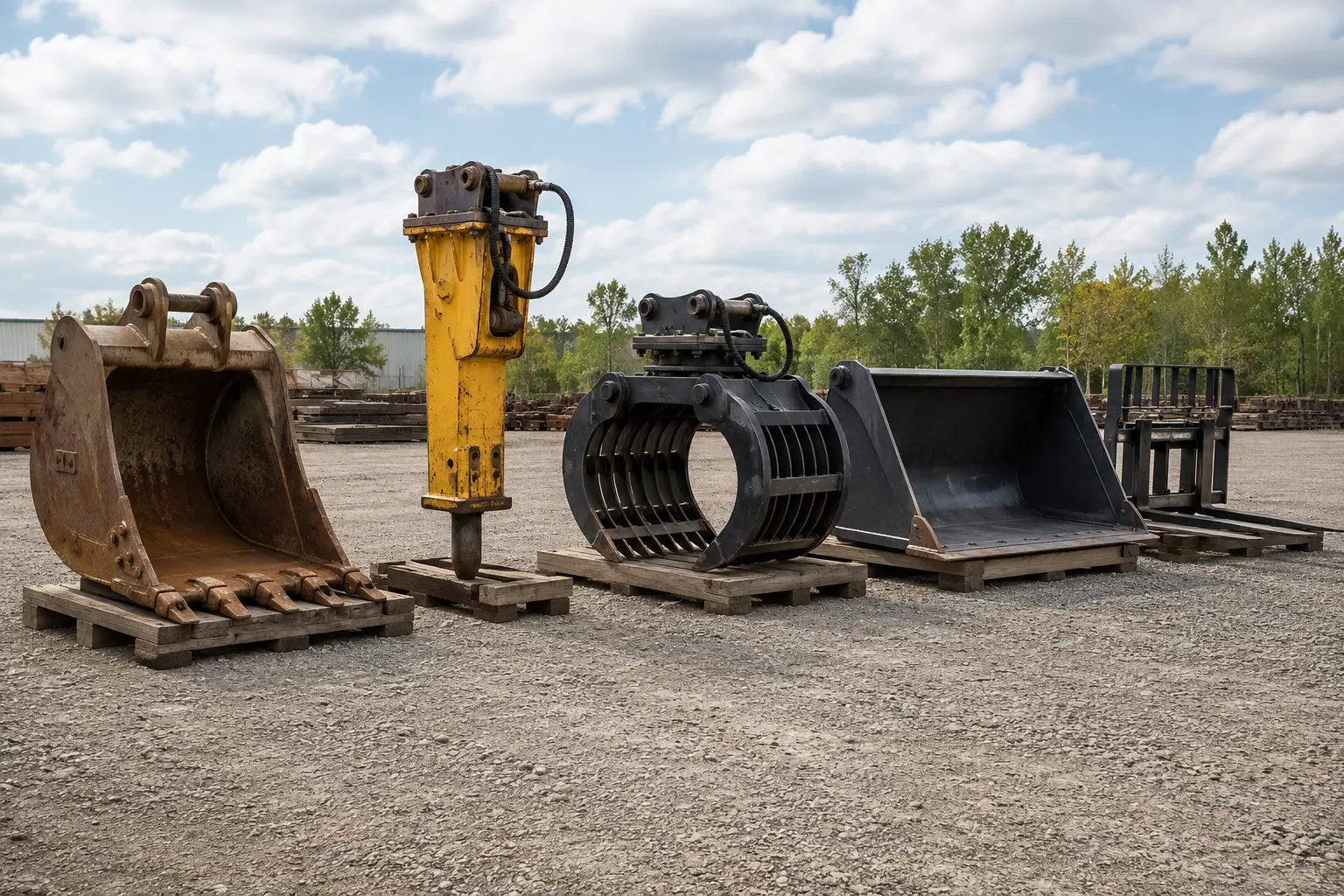
A suitable breaker combines the correct carrier, mounting arrangement, hydraulic setup and work tool. A published machine flow figure is only the start of that check.
Record the complete breaker model, carrier and intended material. Tool diameter alone is not a compatibility rating. Compare the attachment weight and permitted carrier range, then identify whether special conditions such as underwater use require a different approved setup. Keep the breaker manual with the purchase record.
Obtain a hydraulic commissioning record
Ask a qualified supplier to document the required flow, operating pressure, relief setting and return arrangement against the installed carrier circuit. A machine advertised as having auxiliary hydraulics may still need adjustment or additional plumbing. Budget that work before treating a used breaker as ready to connect.
Separate wear items from the purchase price
Request an assessment of tool and bushing wear, housing condition, mounting bracket and service history. Include the required lubrication system and hoses in the quote. An unexplained lack of service records is a reason to obtain a specialist inspection, not evidence by itself that the breaker has failed.
Build the attachment purchase brief
Decision
Evidence to obtain
How to use it
Carrier match
Breaker manual and complete carrier identification
Check attachment weight and approved application
Hydraulic setup
Required settings and a supplier commissioning record
Budget adjustments and plumbing before purchase
Wear allowance
Tool/bushing assessment and itemized quote
Separate initial wear replacement from the asking price
Compatibility factors to verify
Information required
Breaker manual and complete carrier identification
Required settings and a supplier commissioning record
Tool/bushing assessment and itemized quote
Fitment and operating checks
Carrier machine class and serial-specific configuration
Attachment weight, centre of gravity and machine stability
Pin geometry, ear width or exact coupler interface
Hydraulic flow, pressure, return line and case drain where applicable
Auxiliary electrical controls and manufacturer restrictions
Final fitment, stability, hydraulic performance and safe operating limits must be confirmed through applicable manufacturer guidance, a dealer or a qualified attachment supplier.
Related verified model research
A short class-level research path—not an exact-fitment list.
Select a researched model and attachment class to expose what is known and what still needs verification.
No selection in this checker is an attachment approval. Unknown fitment remains unknown.
Technical research & specification evidence
Hydraulic breakers: bracket, breaker body and working tool must be identified separately
Original identification research and qualified issuer references. Actual installed assemblies, serial-specific fitment and safety approval remain unverified.
A breaker assembly contains several different sourcing objects. The carrier bracket connects it to the machine; the breaker body produces impacts; the working tool contacts the material. Research should identify each layer before assigning a spare tool, retainer or carrier application.
Hydraulic breaker attachmentOne enclosed hydraulic-breaker embodiment with one installed pointed working tool. Internal mechanism omitted. Ports,retention,tool fit,pressure,impact energy/frequency,material grade,safety and machine fit unverified. HeavyEQ family research illustration; installed fitment is not established.
Component family researchInstalled fitment not established
Each reference retains its own subject and conditions. A series, model or family name does not establish an installed component, safe setting or interchangeable replacement.
Documented reference
Specifications with configuration evidence
Expand each row before comparing values. Examples, standards metadata and architecture observations retain their original scope.
Epiroc Canada hydraulic breaker families
Hydraulic breakers: bracket, breaker body and working tool must be identified separately: Epiroc Canada hydraulic breaker families
Parameter
Reference value
Evidence
Epiroc breaker overview families
SB, MB and HBEpiroc Canada public overview; exact breaker not selected
Scope & source
Manufacturer family labels only; no shank, retainer, impact-energy or carrier fitment
Reference: Epiroc Canada public overview; exact breaker not selected
Current first-party manufacturer product reference · Descriptive classification; no dimensional datum · Manufacturer reference only; no machine/PIN, installed condition, certification or operating approval established
Source checked 2026-10-15. PUBLIC_REFERENCE_ONLY; no catalogue, manual, media or table reuse licence supplied
Open identification fields (4)
These values have not been established. Unknown, unavailable, unverified and not applicable remain distinct evidence states; none means zero.
Hydraulic breakers: bracket, breaker body and working tool must be identified separately: unresolved identification requirements
Parameter
Evidence state
Required scope
Working-tool retention geometry
Unverified
Exact shank, groove or flat and companion retainer arrangement
Breaker bracket identity
Unverified
Issuer bracket code and both mating interfaces
Return or drain requirements
UnverifiedRequested unit: bar
Applicable exact breaker hydraulic requirements, not inferred from family
Approved carrier package
Unverified
Exact breaker, bracket, working tool and machine arrangement
Draw the identity boundary in words
Record the complete breaker maker and model, body identification and revision, upper bracket or housing, and fitted working tool. A breaker offered without its bracket is a different supply scope from a complete carrier-ready assembly. A chisel-shaped working tool is not the breaker identity. Keep any silenced housing, side-plate arrangement or mounting adapter visible in the record when documented rather than assuming it is included in the body designation.
Family names are not tool dimensions
Epiroc's current breaker overview distinguishes SB, MB and HB families and describes their different application emphasis. That establishes useful manufacturer context without proving a specific working-tool shank or retainer. Do not infer tool dimensions, impact energy or carrier approval from a family abbreviation. If a loose tool has no legitimate identifier, preserve its geometry as an observed research object while its exact manufacturer relationship remains unresolved.
Keep working end and retention geometry separate
For identification, record working-end profile, body or shank shape, retained length, groove or flat arrangement and the companion retainer system where known. Overall tool length is not a substitute for retention geometry. A worn tool observation must remain distinct from an issuer nominal dimension. The exact breaker generation and manufacturer drawing are needed before an interchange relationship can be accepted. No machining allowance, tool grinding, retainer extraction or service tolerance is supplied here.
The bracket is a separate structural investigation
Record bracket issuer, machine-side pin or coupler interface, breaker-side mounting identity and any modification history. A carrier mass class does not determine these features. For a PC210LC-11 inquiry, the model designation alone cannot establish the installed breaker bracket, pin spacing or permitted tool package. Request applicable machine and attachment evidence without creating a fitment edge from a general product page. Keep interface datums and source dates explicit so different generations are not merged.
Hydraulic demand cannot be read from a hose photograph
Supply flow, pressure, return limitations, drain arrangements and any approved lubrication or control equipment need exact configuration evidence. A large hose or an auxiliary switch does not establish those requirements. Retain hydraulic internal research under the existing hydraulics owner, while the bracket and working-tool interface remain here. Do not present generic pressure changes, accumulator service, charging, strike testing or adjustments. Conflicting numerical sources require a technical hold rather than a convenient average.
A used breaker record should expose uncertainty
Request service and inspection history, documented rebuild scope, tool and retainer replacement records, structural alterations and legitimate manufacturer support for the actual arrangement. Cosmetic condition cannot establish impact-mechanism condition or residual life. Distinguish an observed complete assembly from an issuer-approved carrier installation. A useful research result may identify the missing bracket drawing, exact body revision or working-tool code while leaving serviceability and machine approval unresolved. No field repair or return-to-service certification is implied.
Unresolved technical and source questions (2)
No PC210LC-11 bracket, breaker identity, working tool or hydraulic configuration verified.
No repair, accumulator, charging, lock or operating instructions supplied.
Original HeavyEQ analysis and selected source facts. No catalogue reproduction licence, manufacturer endorsement or machine-specific compatibility is implied.