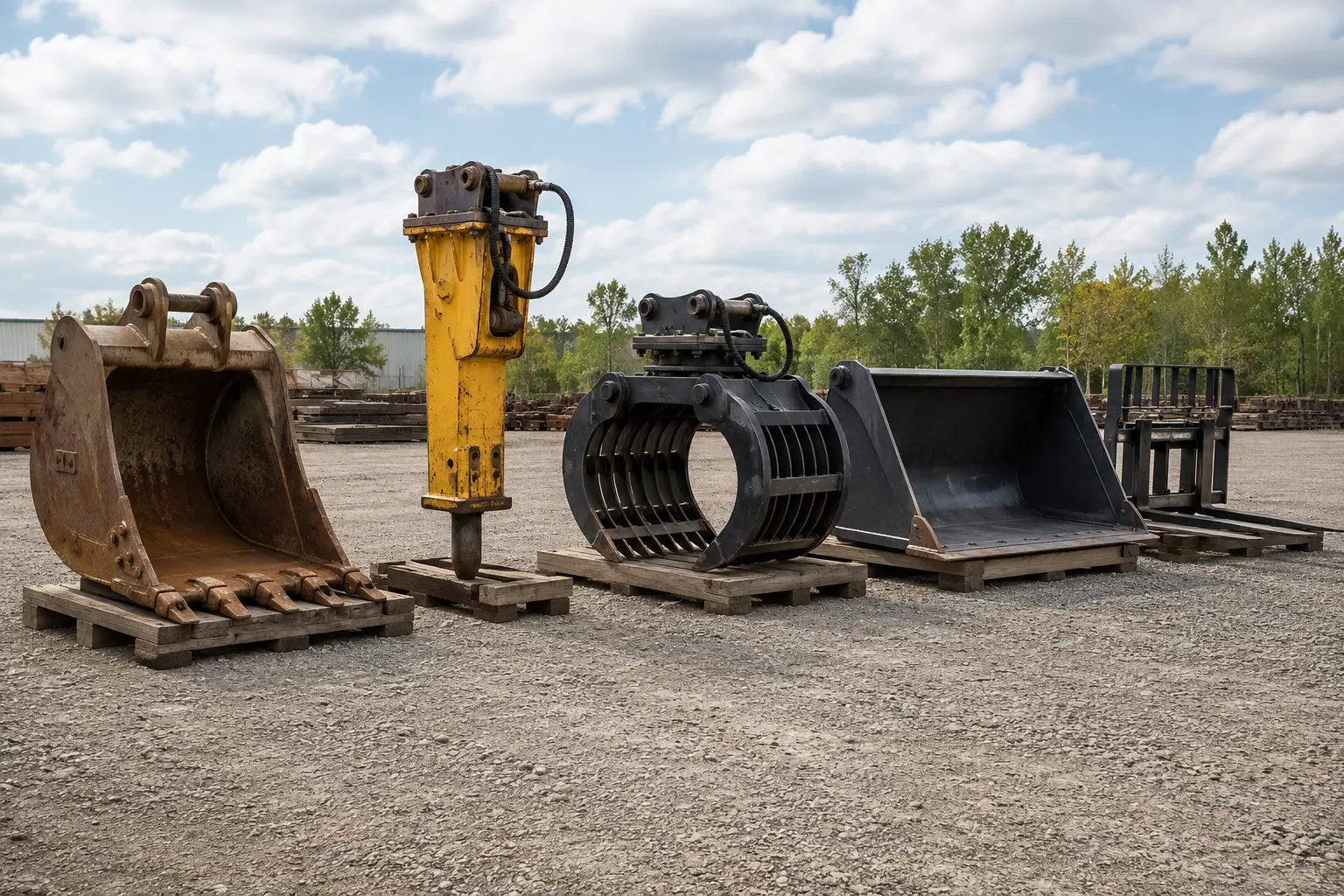
Bucket width, material and installed linkage determine the useful package. Compare capacity only after confirming the duty class and complete carrier interface.
Start with the required trench or grading width and the material being moved. A narrow utility trench, loose stockpile and abrasive rock face call for different shapes and wear protection. Extra bucket capacity is useful only when the carrier can handle the complete loaded tool in the intended work envelope.
Price the complete pickup arrangement
Record pin diameter, pin centres, stick width and the coupler model. Include the bucket, coupler and any tilt unit in the attachment package. Ask the supplier to confirm the complete interface and machine application; matching two pin measurements does not establish clearance through the full linkage movement.
Inspect the structure behind the teeth
Look beyond replaceable teeth and cutting edges. Have the pickup ears, bosses, side plates, floor and weld repairs assessed. Ask for separate prices for wear parts and structural repair so a cheap shell does not become an expensive attachment before its first job.
Build the attachment purchase brief
Decision
Evidence to obtain
How to use it
Trench or grading width
Required finished width and available working space
Choose a bucket shape that produces the required cut
Material and wear duty
Material description and manufacturer duty recommendation
Compare suitable shells and wear protection
Machine interface
Carrier PIN, coupler identification and bucket drawing
Obtain confirmation for the complete assembly
Compatibility factors to verify
Information required
Required finished width and available working space
Material description and manufacturer duty recommendation
Carrier PIN, coupler identification and bucket drawing
Fitment and operating checks
Carrier machine class and serial-specific configuration
Attachment weight, centre of gravity and machine stability
Pin geometry, ear width or exact coupler interface
Hydraulic flow, pressure, return line and case drain where applicable
Auxiliary electrical controls and manufacturer restrictions
Final fitment, stability, hydraulic performance and safe operating limits must be confirmed through applicable manufacturer guidance, a dealer or a qualified attachment supplier.
Related verified model research
A short class-level research path—not an exact-fitment list.
Select a researched model and attachment class to expose what is known and what still needs verification.
No selection in this checker is an attachment approval. Unknown fitment remains unknown.
Technical research & specification evidence
Excavator buckets: capacity, working mass and wear package need a common basis
Original identification research and qualified issuer references. Actual installed assemblies, serial-specific fitment and safety approval remain unverified.
A complete excavator bucket combines structure, mounting and wear equipment. Its capacity is a volume under a specified convention, while its working mass depends on what is included. Research should retain those bases together with the exact bucket identity, rather than treating width or machine weight class as a complete replacement specification.
General-purpose excavator bucketComponent-family research illustration. Verify exact part identification and fitment separately.
Component family researchInstalled fitment not established
Each reference retains its own subject and conditions. A series, model or family name does not establish an installed component, safe setting or interchangeable replacement.
Open identification fields (4)
These values have not been established. Unknown, unavailable, unverified and not applicable remain distinct evidence states; none means zero.
Excavator buckets: capacity, working mass and wear package need a common basis: unresolved identification requirements
Parameter
Evidence state
Required scope
Actual bucket full identity
Unverified
Complete tool and installed wear package required
Capacity with measuring convention
Unverified
Heaped/struck and source standard remain unverified
Working mass and inclusions
Unverified
No bare/GET/coupler mass inferred
Mounting and installation authority
Unverified
Physical geometry does not establish approved fitment
Identify the complete attachment first
Record the bucket maker, full model or assembly code, mounting type and intended duty. Distinguish a complete bucket from its teeth, lip, side protection and coupler. The carrier model can accept different attachment configurations over its service life, so it cannot identify the present bucket by itself. A general-purpose or heavy-duty description is useful context, but needs the issuer’s exact scope and does not supply a universal structural rating.
Manufacturer duty categories have configuration context
Volvo’s excavator-bucket reference distinguishes several duty and working forms, including more extensively protected versions. Those are product-category observations, not approved bucket identities for every listed machine. The European reference is also not Canadian inventory or a serial-specific application source. Keep each bucket’s actual design and wear package separate from the carrier page. A profile description can explain the intended investigation while the exact parent assembly remains unknown.
Capacity requires its source convention
Struck and heaped capacity are different volume definitions. Retain the manufacturer’s stated measuring convention, configuration and native unit with any accepted number. If a page says only capacity, do not silently choose the missing basis. Actual material fill and payload are further questions and must not be inferred from a volume alone. The present reference publishes no average bucket capacity, assumed fill factor or material-density calculation for selecting a machine load.
Mass needs an inclusion statement
A bare bucket, a bucket with GET and a bucket with coupler or other accessories can have different mass boundaries. Keep the source’s explicit inclusions and qualifier, such as from, beside the value. A product photograph does not establish what the numerical mass includes. Do not subtract guessed tooth or adapter masses to manufacture a bare-shell value. Missing inclusion evidence remains a hold even if the page supplies a precise-looking number.
Working geometry and mounting remain independent
Bucket width, tip radius, hinge arrangement and working envelope describe different aspects of the tool. The actual pin-on or coupler interface needs its own identified assembly and approval evidence. Equal pin diameters or a shared class designation cannot prove a complete installation. Structural pins and links retain their existing owner, hydraulics remain with 02A and lock electronics with 02C. The bucket record links those interfaces without duplicating their technical authority.
Prepare an exact research request
Provide the carrier and region, actual bucket markings, mounting and supplied wear package. Keep PIN and repair or conversion history in the private technical packet. Ask a qualified source to resolve the exact assembly, volume basis, mass boundary and applicable installation. No lifting limit, structural repair, welding or attachment-locking process is supplied here. The 320C pilot can retain useful identification guidance while its installed bucket, capacity and GET remain unknown; no year or blanket fitment is invented.
Unresolved technical and source questions (2)
Historical320C installed bucket,capacity and GET unknown.
General/heavy/extreme-duty and fixed/tiltable ditching contexts; European offerings not Canadian inventory or approved pilot installations.
PUBLIC_REFERENCE_ONLY. Original analysis and a few selected scoped facts; no licence for bulk tables, drawings, diagrams, logos, photographs, technical manuals or inventory. Programme editorial/linking acceptance remains required.
Original HeavyEQ analysis and selected source facts. No catalogue reproduction licence, manufacturer endorsement or machine-specific compatibility is implied.
Ditching and tilting buckets: distinguish tool geometry from its actuation
Original identification research and qualified issuer references. Actual installed assemblies, serial-specific fitment and safety approval remain unverified.
A grading or ditching bucket can be fixed or include a tilting mechanism. The complete tool, its carrier mount and the hydraulic equipment that actuates it are different evidence objects. Research should identify the actual bucket and configuration before comparing width, tilt angle or a machine’s auxiliary hydraulic features.
Grading and ditching bucketOne fixed shallow ditch-cleaning/grading-bucket embodiment with smooth lip and top mounting ears. No tilt mechanism. Width,depth,pin pattern,capacity,flow properties,structure and exact fit unverified. HeavyEQ family research illustration; installed fitment is not established.
Component family researchInstalled fitment not established
Each reference retains its own subject and conditions. A series, model or family name does not establish an installed component, safe setting or interchangeable replacement.
Documented reference
Specifications with configuration evidence
Expand each row before comparing values. Examples, standards metadata and architecture observations retain their original scope.
Volvo CE European excavator bucket types
Ditching and tilting buckets: distinguish tool geometry from its actuation: Volvo CE European excavator bucket types
Parameter
Reference value
Evidence
Volvo ditching reference distinction
Fixed and tiltable forms separately describedEuropean family description only
Scope & source
Manufacturer product-form distinction
Reference: European family description only
Issuer-published attribute; not an independent measurement · Complete tool architecture · No Canadian bucket or actuator installation selected
General/heavy/extreme-duty and fixed/tiltable ditching contexts; European offerings not Canadian inventory or approved pilot installations.
Web page checked 2026-10-15; no numbered document edition observed
No machine-specific, installed or serial-verified fitment established.
Volvo CE European excavator bucket types ↗ · General/heavy/extreme-duty and fixed/tiltable ditching contexts; European offerings not Canadian inventory or approved pilot installations.
Source checked 2026-10-15. PUBLIC_REFERENCE_ONLY. Original analysis and a few selected scoped facts; no licence for bulk tables, drawings, diagrams, logos, photographs, technical manuals or inventory. Programme editorial/linking acceptance remains required.
Open identification fields (2)
These values have not been established. Unknown, unavailable, unverified and not applicable remain distinct evidence states; none means zero.
Ditching and tilting buckets: distinguish tool geometry from its actuation: unresolved identification requirements
Parameter
Evidence state
Required scope
Actual bucket and mounting identities
Unverified
Full tool and coupler/pin-on configuration required
Actual tilt actuation and working envelope
Unverified
02A hydraulic relationship and exact configuration unverified
Identify the working form
Record whether the tool is a fixed grading bucket, ditching bucket, tilting bucket or another issuer-defined assembly. A wide smooth cutting edge does not identify a tilting mechanism. A bucket used through a tiltrotator is also not necessarily a bucket containing its own tilt mechanism. Keep those architectures separate. The complete bucket identity and intended supplied boundary determine which pivots, actuators and wear components belong in the research packet.
A scoped manufacturer distinction
Volvo’s European bucket reference separately describes fixed and tiltable ditching buckets. That distinction supports a useful identification question without assigning a tool to a Canadian pilot. The page’s tilt capability belongs to its described product context, not every ditching bucket. The article therefore uses only the fixed-versus-tiltable distinction and accepts no numerical angle as an installed-machine specification. A different manufacturer’s tilt bucket or hydraulic package requires its own evidence.
Width and volume retain their basis
Working width, outside envelope and any side protection need named datums. A nominal width does not establish capacity, mass or mounting geometry. Preserve the source’s heaped/struck convention and mass inclusions if later numerical fields are accepted. An unspecified capacity label should remain unresolved. Do not estimate a wide bucket’s payload from its appearance or assume that the carrier’s published bucket range approves every grading or ditching configuration.
Tilt mechanism and hydraulic requirements stay linked but separate
The complete structural bucket belongs here; the actual cylinder, hoses and hydraulic components retain 02A ownership. Record their relationship only when the applicable source identifies it. A carrier advertised with auxiliary flow does not prove the installed tilt circuit, control arrangement or compatible actuator. Electronic controls and interlocks remain with 02C. This reference provides no pressure setting, hose routing, connection, motion test or procedure for adding a tilt function.
Mounting and working envelope need actual configuration
A pin-on hanger, coupler or tiltrotator can change the overall tool arrangement. Keep upper and lower interfaces distinct where applicable and retain any stated installation conditions. Matching pin geometry cannot establish load approval or the complete motion envelope. Earlier bucket or coupler changes also require reconciliation with original machine documentation. A source listing related machines or general class ranges is a research lead, not serial-specific fitment for the actual combination.
Build a reviewable request
Provide the accepted carrier, region, bucket markings, fixed or tilting architecture, mount and supplied scope. Keep PIN and private configuration history in the technical packet. Ask a qualified source to establish the exact bucket and actuation relationship. The KX040-5 pilot’s attachment descriptions can support investigation while its actual ditching/tilt bucket and circuit remain unknown. No operating envelope, WLL, structural repair or locking procedure is supplied, and no supplier availability is inferred.
Unresolved technical and source questions (2)
KX040-5 actual tilt/ditching tool and hydraulic circuit unknown.
No pressure,tilt-angle or installation recipe inferred.
General/heavy/extreme-duty and fixed/tiltable ditching contexts; European offerings not Canadian inventory or approved pilot installations.
PUBLIC_REFERENCE_ONLY. Original analysis and a few selected scoped facts; no licence for bulk tables, drawings, diagrams, logos, photographs, technical manuals or inventory. Programme editorial/linking acceptance remains required.
Original HeavyEQ analysis and selected source facts. No catalogue reproduction licence, manufacturer endorsement or machine-specific compatibility is implied.
Narrow and specialist buckets: width does not establish the complete working tool
Original identification research and qualified issuer references. Actual installed assemblies, serial-specific fitment and safety approval remain unverified.
Trenching, rock and other specialist buckets have distinct geometry and duty contexts. A narrow width or a familiar carrier class does not identify their mounting, capacity or wear package. Research should preserve the actual complete bucket and question ambiguous source values before converting them into apparently precise specifications.
Narrow trench bucketOne narrow trench-bucket embodiment with three teeth and top pin ears. Tooth count,shell proportions,pin layout,capacity,structure,materials and exact fit unverified. HeavyEQ family research illustration; installed fitment is not established.
Component family researchInstalled fitment not established
Each reference retains its own subject and conditions. A series, model or family name does not establish an installed component, safe setting or interchangeable replacement.
Open identification fields (3)
These values have not been established. Unknown, unavailable, unverified and not applicable remain distinct evidence states; none means zero.
Narrow and specialist buckets: width does not establish the complete working tool: unresolved identification requirements
Parameter
Evidence state
Required scope
Actual specialist bucket identity
Unverified
Exact full tool and wear package required
514-7846 numerical reference fields
Unavailable
Current paired-value conflicts require issuer clarification
Actual mounting and working-envelope evidence
Unverified
No complete configuration inferred from nominal width
Name the actual specialist tool
Identify whether the item is a narrow trenching bucket, rock bucket, skeleton form or another issuer-defined attachment. Keep its exact model and supplied wear components separate from a general-purpose bucket description. A carrier’s nominal size may organize the enquiry but cannot identify the tool. The actual mounting and prior changes also matter; a narrow bucket fitted through a coupler or tiltrotator has another assembly context from a directly pinned tool.
A current source exposes a real data-quality hold
The reviewed Cat 514-7846 trenching-bucket page has inconsistent paired dimensions and mass values. The title, width and conversion pairs cannot all be treated as a validated configuration. Those numerical fields are quarantined for issuer clarification rather than corrected by choosing the more plausible number. The page still provides qualitative trenching context, but no exact bucket measurement or installation is accepted from the disputed table. This is a source hold, not a reason to stop unrelated original identification guidance.
Width and clearance are separate observations
Retain the source-defined cutting width, outside envelope and relevant mounting dimensions independently. A labelled trenching width does not settle side protection or tool clearance. Do not derive a replacement width from a pipe diameter or a machine’s track spacing. If a source’s native values conflict, preserve both in the evidence review and keep the public field null. A conversion should be labelled as derived only after its original source value and context are established.
Duty and wear-package identity remain independent
A rock or heavy-duty label does not identify the exact teeth, adapters, side protection or material specification. Record the actual issuer terms and any documented application conditions. A bucket can share a family description while using a different nose, edge or mounting. No profile photograph establishes a complete wear package. The guide does not infer hardness, breakout capability, fatigue life or structural repair suitability from a generic specialist-duty category.
Mounting approval needs the complete combination
A pin-on description, coupler family or tiltrotator application reference is only one part of the installed assembly. Retain exact hardware and configuration conditions; do not import a broad catalogue compatibility statement into a specific carrier edge. The 305CR pilot therefore remains an investigation of the actual bucket and interface. Hydraulic functions keep 02A ownership and electronic controls remain with 02C. No new component installation or lower-assembly relationship is invented to close the missing evidence.
Ask for evidence that resolves the ambiguity
Provide the carrier, actual bucket marks, mounting, intended duty and supplied scope. Keep machine PIN and private change history in the review packet. Ask a qualified source for an applicable dimensioned reference and configuration confirmation where the public page conflicts. No excavation method, lifting limit, repair, drilling or locking process is supplied here. The article supports a technically specific enquiry while actual bucket identity, dimensional values and serial fitment remain held, with no current stock or seller claim.
Unresolved technical and source questions (2)
Cat514-7846 width and mass conversion conflicts held; no silent correction.
305CR exact bucket and pin/coupler interface unknown.
Title and ProductSpecifications have inconsistent paired width and mass values. Numerical fields and exact configuration assertions held for issuer clarification; qualitative narrow-profile research context only.
PUBLIC_REFERENCE_ONLY. Original analysis and a few selected scoped facts; no licence for bulk tables, drawings, diagrams, logos, photographs, technical manuals or inventory. Programme editorial/linking acceptance remains required.
General/heavy/extreme-duty and fixed/tiltable ditching contexts; European offerings not Canadian inventory or approved pilot installations.
PUBLIC_REFERENCE_ONLY. Original analysis and a few selected scoped facts; no licence for bulk tables, drawings, diagrams, logos, photographs, technical manuals or inventory. Programme editorial/linking acceptance remains required.
Original HeavyEQ analysis and selected source facts. No catalogue reproduction licence, manufacturer endorsement or machine-specific compatibility is implied.
Pin-on excavator attachment interfaces: describe both joints before comparing tools
Original identification research and qualified issuer references. Actual installed assemblies, serial-specific fitment and safety approval remain unverified.
A pin-on attachment inquiry should describe the complete connection between stick, linkage and tool. A matching pin diameter answers only one geometric question. The useful research result is an unambiguous interface record tied to the actual attachment and carrier configuration, with load approval left separate from dimensional resemblance.
Pin-on attachment mounting interfaceThree separate items:a representative two-ear pin-on saddle and two loose plain pins. Not a matched kit or installed joint. Bore/pin sizes,spacing,retention,lubrication,strength and attachment fit unverified. HeavyEQ family research illustration; installed fitment is not established.
Component family researchInstalled fitment not established
Each reference retains its own subject and conditions. A series, model or family name does not establish an installed component, safe setting or interchangeable replacement.
Open identification fields (5)
These values have not been established. Unknown, unavailable, unverified and not applicable remain distinct evidence states; none means zero.
Pin-on excavator attachment interfaces: describe both joints before comparing tools: unresolved identification requirements
Parameter
Evidence state
Required scope
Stick-joint pin diameter
UnverifiedRequested unit: mm
Nominal issuer diameter of the attachment-to-stick joint, distinct from a worn observation
Link-joint pin diameter
UnverifiedRequested unit: mm
Nominal issuer diameter at the bucket-link joint
Pivot centre spacing
UnverifiedRequested unit: mm
Distance between the two named pin axes
Lug clear width
UnverifiedRequested unit: mm
Unambiguous inside bearing-face separation
Approved carrier arrangement
Unverified
Exact issuer-approved machine, stick and attachment arrangement
Map the connection before naming its size
Begin with an identity sketch in words: which attachment lug connects to the stick, which connects to the bucket link, and which items are included in the assembly being offered for research. A loose bucket, a bucket with pins, and a bucket with a coupler hanger are different objects. Record the maker and any legible assembly identifier before interpreting an auction description. Name the two pivot axes consistently so a later measurement can be assigned to the correct joint.
Use a distinct datum for each dimension
Keep pin nominal diameter, observed journal condition, lug inside width and pin-centre spacing in separate fields. Centre spacing describes the distance between pivot axes; overall hanger length describes an envelope. Neither replaces the other. Identify whether a quoted width spans outside plates, the clear gap between plates, or a particular bearing face. Record original units and whether a dimension came from a manufacturer drawing or an independent observation. Leave tolerances and permissible wear unknown when no applicable criteria exist.
Pin-on and coupler-ready descriptions need context
The current Takeuchi TB260 configurator distinguishes pin-on buckets intended for its hydraulic pin-grabber arrangement from a separate mechanical quick-coupler bucket group. That is a useful manufacturer-specific example of why the word bucket alone does not identify the complete mating arrangement. For an independent comparison, keep the tool hanger, any intermediate coupler and the machine linkage as separate records. Do not copy a compatible-product menu into a serial-qualified installation assertion.
Retainers and bearing stacks belong in the record
Request the retention style at each pin, included bushings or sleeves, sealing components and any side-specific spacers as identification evidence. A photograph may show that hardware is present but may not identify its grade, revision or suitability. Describe visible alterations and incomplete components as unresolved observations. A sourcing record should state whether the supplied assembly includes pins and retainers, rather than silently assuming hardware will transfer from the old attachment. Reuse decisions need the applicable manufacturer evidence.
Geometry affects more than attachment pickup
A candidate tool can present the right connection geometry while its mass, centre of gravity or working envelope differs from the previous assembly. The comparison therefore needs bucket or tool mass basis, pin-to-working-edge geometry, intended duty and the actual carrier arrangement. These are selection questions, not an authorization to test an uncertain combination. Keep hydraulic cylinder identity and geometry with the existing hydraulics research owner; keep structural link and bore identity with structural-joint research.
Build a useful unresolved inquiry
A complete inquiry names the carrier identity, installed stick and linkage arrangement, attachment issuer, mount description, dimension datums, hardware scope and source dates. Add separate questions for manufacturer application approval, load limitations and evidence of modification. If the pin-on drawing is missing, publish the identification method and retain blank dimensions. If the installed assembly is uncertain, preserve that uncertainty instead of deriving a bucket identity from excavator model or nominal machine class. No pin-removal, fabrication or re-boring procedure is supplied here.
Unresolved technical and source questions (2)
No exact pin geometry, permissible wear, service hardware or installed machine approval supplied.
Manufacturer catalogue association remains separate from observed installation.
Original HeavyEQ analysis and selected source facts. No catalogue reproduction licence, manufacturer endorsement or machine-specific compatibility is implied.