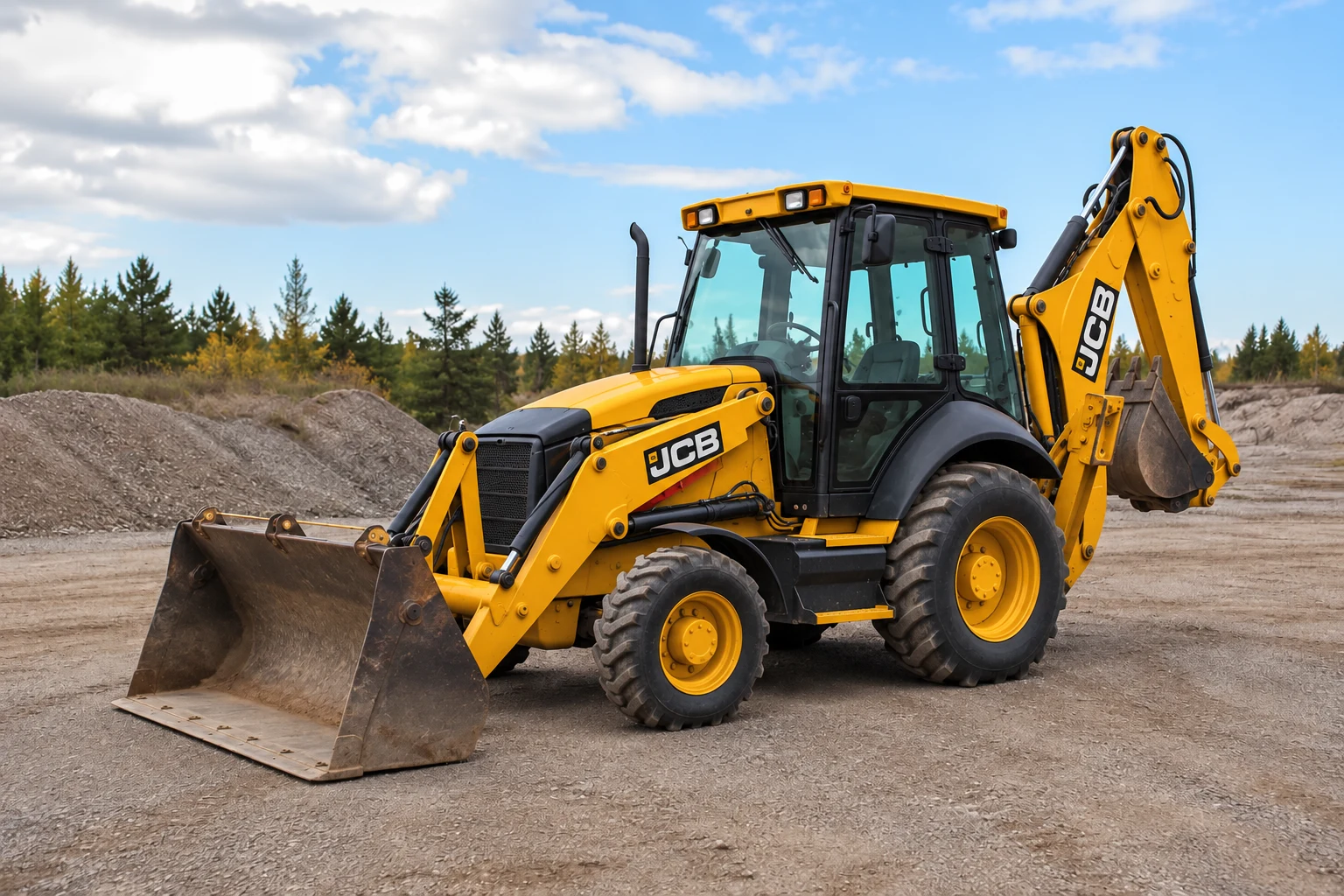
Identify the digging arrangement
Record the exact model, region, centre-mount or sideshift arrangement, and standard or extending dipper. Identify which position the published depth and reach describe. Compare reach from the swing pivot with the same definition on other backhoes. Keep loader measurements separate from backhoe loading height; the two ends do different work and use different geometry.
Plan the stabilizer and loader workspace
Measure the proposed setup area and identify ground support, access and clearance. Consider where the loader bucket and stabilizers will sit while the backhoe is used. Check the intended bucket, forks or other front tool with the correct machine guidance. A backhoe that fits through an entrance may still need more room to establish a suitable working setup.
Inspect both ends and the carrier
Ask for assessment of the swing tower or kingpost, stabilizer pivots, dipper wear, loader linkage and coupler. Include axles, transmission, steering and brakes in the inspection scope. Have a competent operator demonstrate the functions under agreed conditions. Document the extending mechanism and its wear separately where fitted; a basic bucket cycle leaves important questions unanswered.
Compare versatility with the actual schedule
List digging, loading and repositioning tasks and estimate how often the machine changes role. Confirm included buckets, forks and hydraulic circuits. Add setup, transport and attachment handling to the cost model. If the job still requires a second loader or excavator throughout the day, compare that complete package with alternatives instead of valuing versatility that will rarely be used.
Decision worksheet
| Decision | Evidence to collect | How it changes the shortlist |
|---|---|---|
| Dipper and mount | Installed arrangement and measurement basis | Keeps depth and reach comparisons valid |
| Setup footprint | Stabilizer position and site space | Confirms a practical working area |
| Two working ends | Separate loader and backhoe inspection | Avoids overlooking half the package |
Before you decide
Questions to close out
- Identify dipper and mount arrangement.
- Inspect stabilizers and swing structure.
- Check axles, brakes and transmission.
- Record all included front and rear tools.
A backhoe earns its versatility when the task sequence actually uses both ends. Inspect and cost it around that sequence rather than a single impressive digging number.
Continue your research
Sources and further reading
Technical references supporting this guide. Machine manuals and documentation for the actual configuration remain essential when applying the guidance.