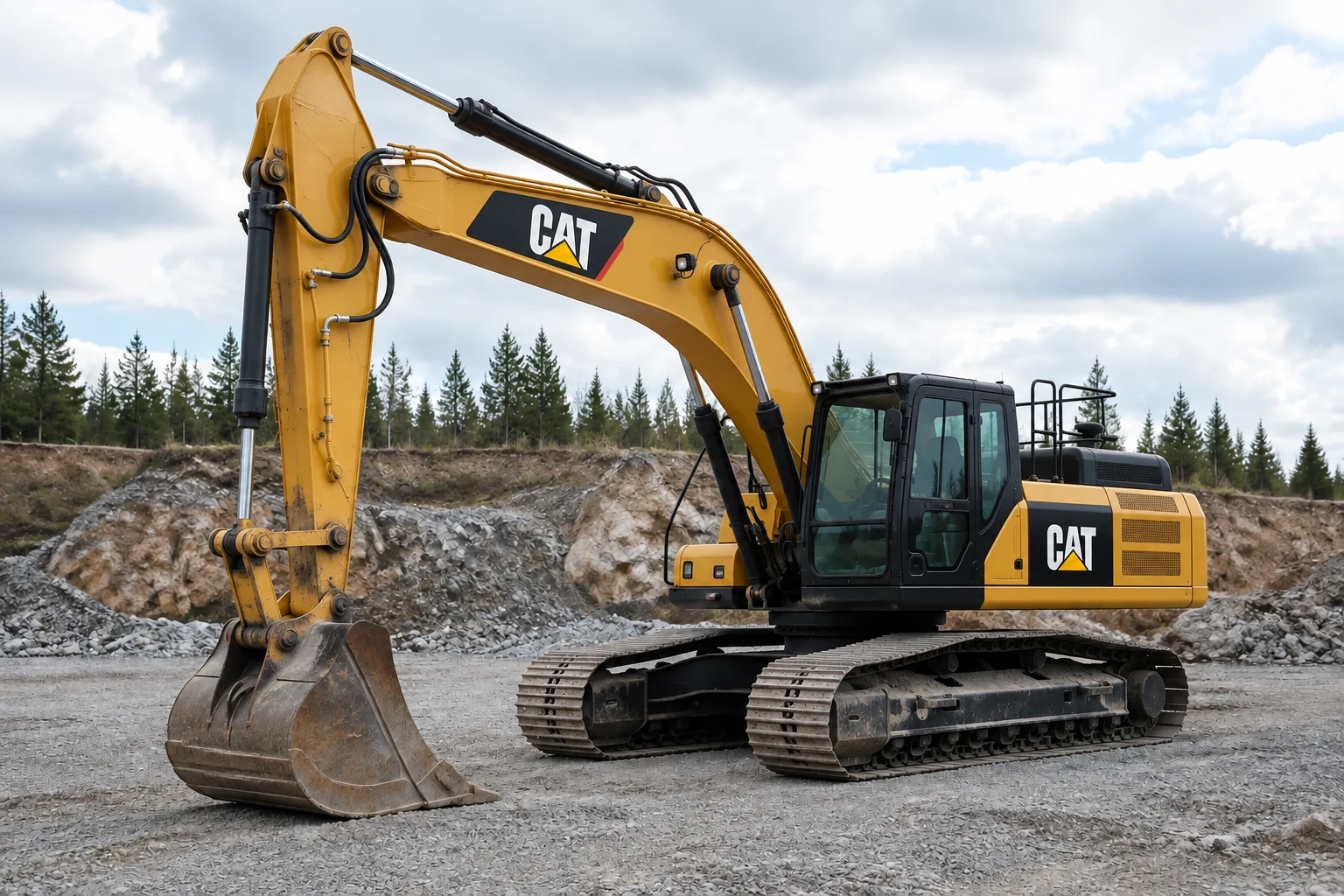
Map a representative working day
Write out the sequence of tasks: travel to the work area, prepare the setup, excavate, handle spoil, load material and move again. Record where a second machine or operator would be needed. A backhoe combines loader and excavator functions, but it does not perform both simultaneously. An excavator's working envelope and attachments should be judged against its actual position on the site.
Check geometry at the working position
Distinguish reach from a backhoe swing pivot from an excavator reach measurement and keep their manufacturer terminology. Confirm digging depth with the installed dipper or arm, and check clearance at the proposed spoil or truck location. For a backhoe, include stabilizer footprint and the available setup space. For either machine, use the correct lifting information for lifting tasks.
Consider surfaces and repositioning
Evaluate the approach, ground support, turning room and planned moves. Do not infer road-use permission or transport suitability from the presence of tires. A transport provider should assess the complete travel arrangement when a carrier is required. On constrained sites, measure the working footprint as well as the minimum access opening; a machine that enters may still lack room to work.
Price the supporting equipment
Include buckets, couplers, forks, auxiliary hydraulics and any second machine required by the work plan. Ask how often tools must be exchanged and how they travel. Compare inspection findings across the appropriate systems: a backhoe adds loader, axle and stabilizer questions to the digging equipment; a crawler excavator brings track-system and swing-system considerations.
Decision worksheet
| Decision | Evidence to collect | How it changes the shortlist |
|---|---|---|
| Task mix | Time spent digging, loading and moving | Shows where a combined machine helps |
| Setup space | Stabilizers, swing clearance and ground support | Checks whether the work position is practical |
| Support equipment | Second machine, operator and tools | Makes the total job budget comparable |
Before you decide
Questions to close out
- Describe a full day of tasks.
- Check the installed arm or dipper.
- Measure the working setup area.
- Budget the complete support package.
The useful comparison is the cost and practicality of completing the job with each equipment package. Keep production assumptions separate from maximum brochure dimensions.
Continue your research
Sources and further reading
Technical references supporting this guide. Machine manuals and documentation for the actual configuration remain essential when applying the guidance.