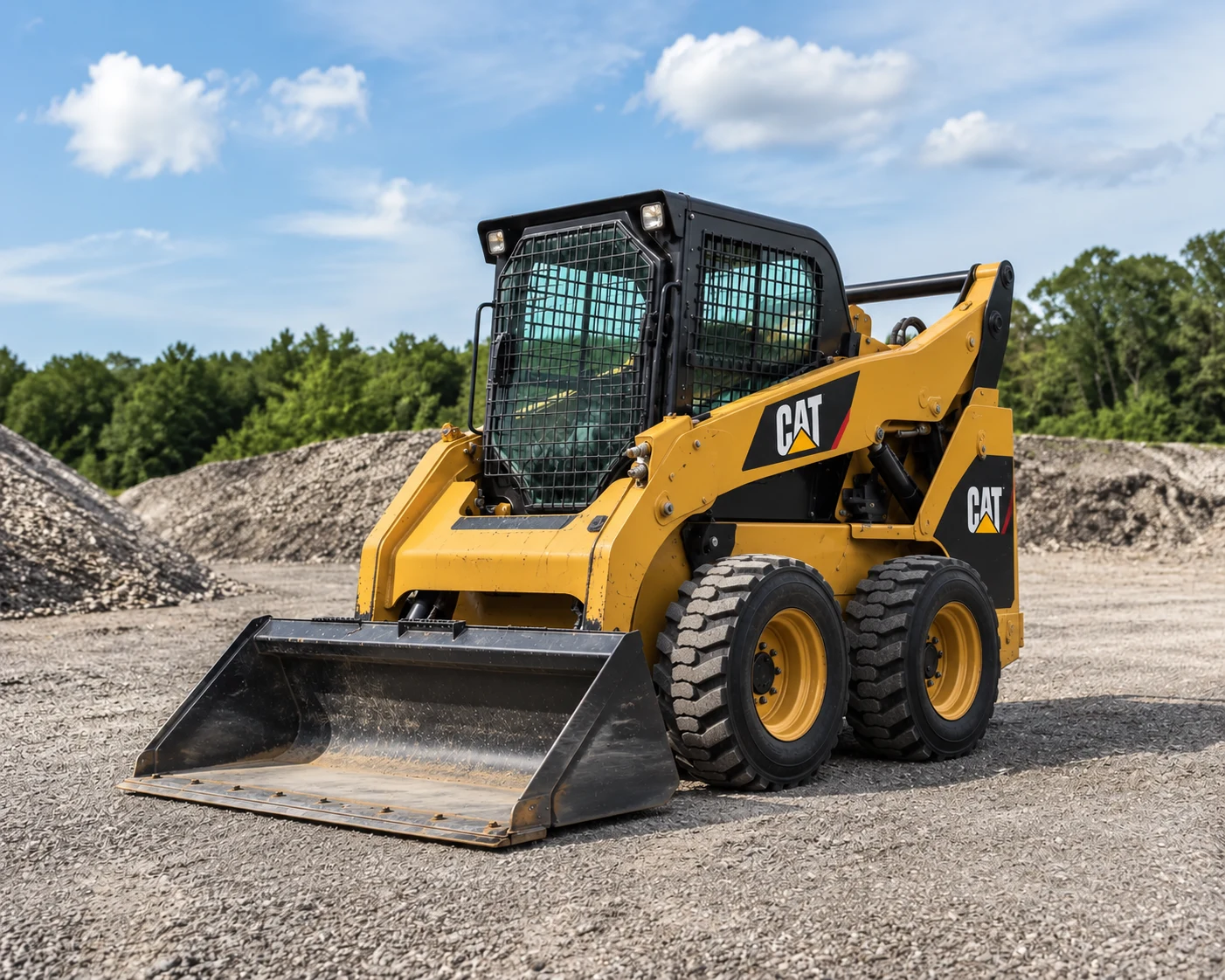
Start with the work calendar
List the surfaces, travel distances and seasonal conditions for your typical jobs. Separate compacted yards and pavement from soft ground and sensitive finished surfaces. Ask for a demonstration that resembles the intended work. Neither machine type guarantees access on weak ground, and track width alone does not establish whether a site can support the loaded machine.
Compare the whole loading task
Use the intended bucket or forks and the required delivery height. Lift path, reach, attachment weight and the applicable capacity basis matter together. Rated operating capacity is not interchangeable with tipping load. Two machines with a similar headline number may have different geometry at the point where you need to place material. Verify the rating in the manufacturer's stated configuration.
Assess the installed hydraulic package
Write down the attachment's flow, pressure, return and electrical requirements and compare those with the fitted machine. Do not assume a high-flow label includes every circuit an attachment needs. Have the supplier confirm the complete pairing. This can remove a candidate from the shortlist even when its running gear looks ideal for the site.
Compare wear and mobilization together
Price the actual tires or complete track system and the condition of the drive components. Include loading, trailer capacity, attachment storage and the number of moves between jobs. Use consistent annual productive hours when comparing cost. A machine that spends much of its week travelling or being transported should not be evaluated using the utilization of one permanently assigned to a site.
Decision worksheet
| Decision | Evidence to collect | How it changes the shortlist |
|---|---|---|
| Surface and travel | Typical route, ground and seasonal work | Prioritizes appropriate running gear |
| Loading geometry | Reach and clearance with the intended tool | Checks whether the machine can place the load |
| Wear cost | Tire or track-system condition and quotes | Replaces a generic cost assumption with evidence |
Before you decide
Questions to close out
- Trial the intended attachment.
- Compare matching capacity definitions.
- Check transport weight with all carried tools.
- Price the actual wear system before choosing.
Build two complete job packages and compare their delivered cost and suitability. The best running gear cannot compensate for an incompatible attachment or an unreachable loading target.
Continue your research
Sources and further reading
Technical references supporting this guide. Machine manuals and documentation for the actual configuration remain essential when applying the guidance.