Build your transport record
Record one actual travel configuration. Include a unit with every measurement and leave unknown values blank. These notes are not sent to a carrier or saved when you leave this page; download a copy to keep or share.
0 of 13 fields recorded. Blank fields will be marked as unresolved in the download.
The completed record supports the carrier's loading and route assessment. It is not a permit, a lifting plan or confirmation of transport eligibility.
Start with identity and posture
Record manufacturer, complete model, serial/PIN and the date of measurement. Describe boom, blade, bucket, conveyor, mast, stabilizers and any folding arrangement that changes the travel envelope. Add cab or canopy, tires or tracks and counterweight where relevant. Use clear photographs of the same posture being measured. Do not combine length from one arrangement with height from another.
Record the three overall dimensions
Identify the foremost and rearmost travel points, the widest included points and the highest included point. State whether mirrors, antenna, bucket or removable accessories are included. Record the original measured value and unit before producing a converted display. If a measurement is inaccessible or unsafe to obtain, ask qualified personnel to complete it and keep the field unresolved until then.
Record weight and separate pieces
Use a documented weight for the actual configuration or arrange appropriate weighing. State the evidence and what it includes. List detached buckets, forks, counterweights, boom sections, batteries or other components separately with available handling information. A shipping weight for a stripped machine cannot silently stand in for a fully equipped operating machine.
Send the sheet with a loading brief
Include operating status, loading assistance, ground conditions, pickup and delivery contacts and timing. Ask the carrier to assess the loaded combination and route. The carrier needs its own vehicle dimensions and axle/loading information; the machine sheet supplies only part of that assessment. Keep changes to the machine configuration visible and resend the sheet if an attachment is added before collection.
Shipping weight and operating weight: check the included equipment
Do not choose a transport weight from its label alone. Match the manufacturer record to the actual cab or canopy, tracks or tires, stick, counterweight, blade, bucket and other fitted equipment. Keep the original inclusion note with the value. For example, the Cat 305 CR source reviewed for this guide excludes the bucket from its published minimum and maximum cab-weight configurations; the John Deere 50 P-Tier ME50PAU brochure includes a bucket in its general reference configuration unless otherwise noted. Those records are examples of different measurement bases, not weights for your machine.
For a mini excavator or skid steer, document the fitted bucket or forks, coupler and counterweight before using a reference weight. For a dozer, identify the blade and rear equipment. For detached excavator attachments, list each piece separately and state whether its weight is already included in the machine figure. Avoid counting the same component twice. If the configuration cannot be matched, leave the transport weight unresolved and obtain suitable evidence for the actual machine.
Excavators, loaders and dozers: record the travel envelope
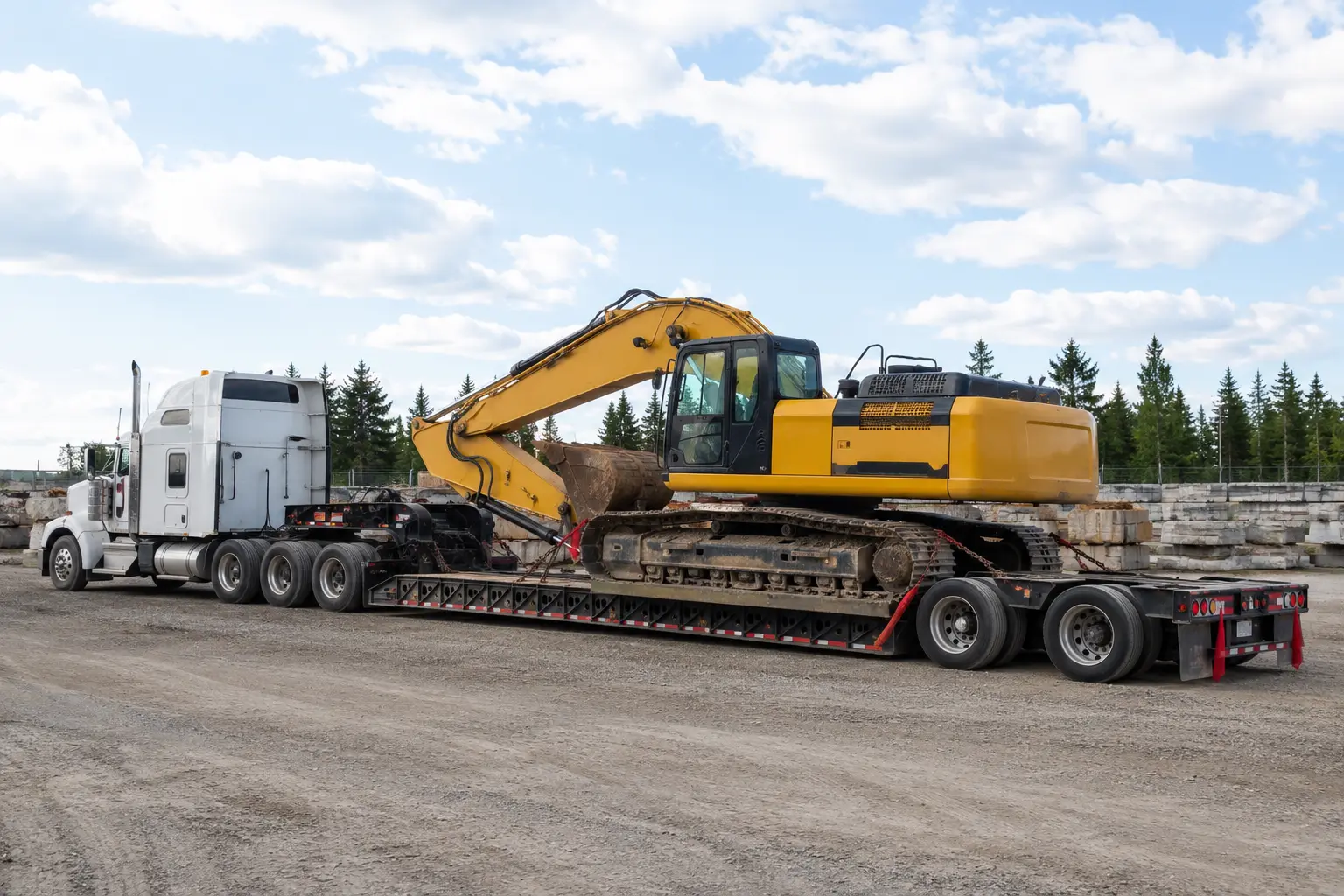
For an excavator, describe the boom and stick posture, bucket or attachment position and any removed components in the same photographs used for the measurements. Identify the two points that define the measured length. A digging reach figure is not a substitute for this travel measurement.
For a wheel loader, record the fitted work tool, articulation position and highest included point. For a dozer, document blade posture and rear-mounted equipment. Record the configuration specified for transportation in the applicable machine instructions; do not reposition or dismantle a machine solely to obtain a smaller number without a suitable procedure and qualified personnel. Use the model links below to locate reference information, then confirm it against the actual machine.
Loaded height: keep the machine and vehicle records separate
Machine height is measured from its supporting surface; the loaded combination is measured from the road to its highest included point. For a machine resting on a deck, planning arithmetic is road-to-deck height plus machine height above its contact surface plus any packing beneath it, all in the same unit. Clearly label this as an estimate and check which component is actually highest. Do not add a guessed trailer height to a brochure dimension and report it as measured loaded height.
Have the carrier confirm the actual loaded height and the vehicle/load configuration used for its route assessment. Ontario guidance addresses the vehicle and load together and assesses weight allowances using axle configuration and spacing. This worksheet does not determine permit requirements or clearance for any Canadian route.
Centre of gravity and handling information
Add the available manufacturer handling or centre-of-gravity documentation for the actual configuration and tell the carrier what has been removed or repositioned. Outer dimensions and total weight alone do not describe how mass is distributed. Do not assume the centre of gravity is the geometric midpoint or treat an estimated point as a lifting instruction.
If this information is needed for loading or handling and is unavailable, flag the gap for the carrier and qualified personnel before arranging the operation. Keep separate-piece lifting and handling instructions with the piece they describe. This record collects information; it does not design a lift or a securement arrangement.
Decision worksheet
| Decision | Evidence to collect | How it changes the shortlist |
|---|---|---|
| Overall envelope | Length, width and height in one photographed posture | Avoids mixed-configuration dimensions |
| Weight | Evidence and included components | Supports the actual loading assessment |
| Separate items | Inventory and handling requirements | Reveals additional deck or lifting needs |
Before you decide
Questions to close out
- Use one clearly described travel posture.
- Retain original units and measurement notes.
- List detached pieces individually.
- Confirm the final package before dispatch.
A useful transport sheet is specific enough for another person to repeat the measurement and understand its limits. It complements the carrier assessment rather than replacing it.
Continue your research
Sources and further reading
Technical references supporting this guide. Machine manuals and documentation for the actual configuration remain essential when applying the guidance.