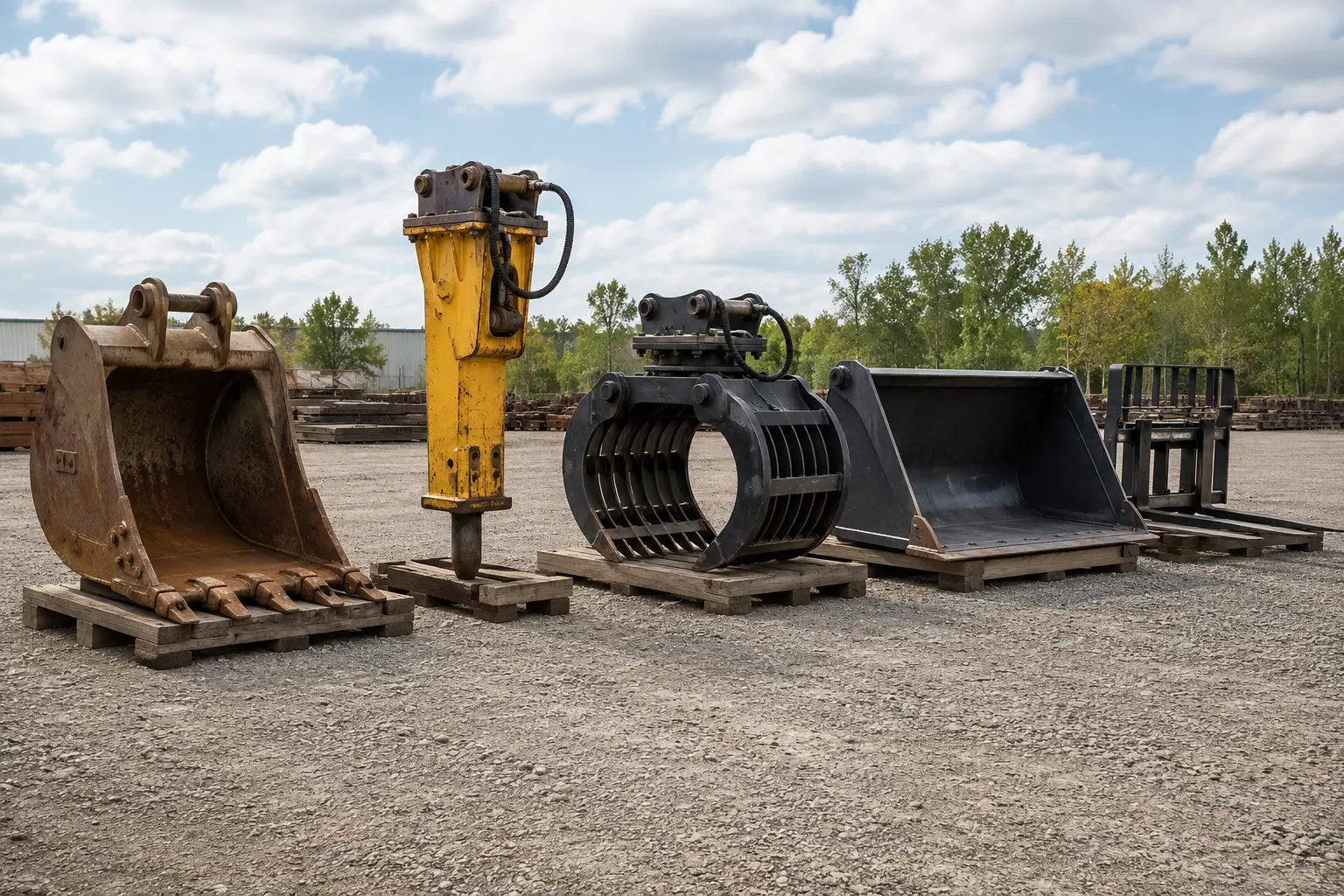
Start with the work that occupies most machine hours: moving material, finish grading, snow work, drilling or vegetation management. List the required width and output before selecting a tool. A specialist attachment may justify its cost for recurring work while an occasional task may be better handled with a rented package.
Match more than the mounting plate
Record attachment weight, hydraulic requirements, electrical controls and the exact loader configuration. A familiar mounting plate does not establish hydraulic suitability or permitted capacity. Compare the attachment requirements with the circuit actually installed, including any return or case-drain requirements specified for that tool.
Compare the usable package
Price hoses, controls, wear parts and initial fitting together with the attachment. Consider how the tool will be transported and stored between jobs. A loader with several attachments is not several machines working simultaneously; include changeover and travel time when evaluating the expected workload.
Build the attachment purchase brief
Decision
Evidence to obtain
How to use it
Job and width
Recurring work and access requirements
Choose the tool that performs the actual task
Installed hydraulic package
Loader build information and attachment manual
Confirm the supplied circuit can support the tool
Complete ownership package
Fitting, wear, transport and storage quotes
Compare usable packages rather than bare attachments
Compatibility factors to verify
Information required
Recurring work and access requirements
Loader build information and attachment manual
Fitting, wear, transport and storage quotes
Fitment and operating checks
Carrier machine class and serial-specific configuration
Attachment weight, centre of gravity and machine stability
Pin geometry, ear width or exact coupler interface
Hydraulic flow, pressure, return line and case drain where applicable
Auxiliary electrical controls and manufacturer restrictions
Final fitment, stability, hydraulic performance and safe operating limits must be confirmed through applicable manufacturer guidance, a dealer or a qualified attachment supplier.
Related verified model research
A short class-level research path—not an exact-fitment list.
Select a researched model and attachment class to expose what is known and what still needs verification.
No selection in this checker is an attachment approval. Unknown fitment remains unknown.
Technical research & specification evidence
Compact-loader attachment plates: mounting geometry and powered connection are separate
Original identification research and qualified issuer references. Actual installed assemblies, serial-specific fitment and safety approval remain unverified.
A compact-loader attachment plate must be identified as an actual interface, not merely described as universal. The record needs the carrier-side mount, attachment-side plate, retention arrangement and any separate hydraulic or electrical equipment. Similar appearance across loaders is a research lead rather than complete compatibility evidence.
Skid-steer quick-attach plate and latchOne open-frame quick-attach carrier embodiment with two manual lever/wedge regions. Attachment-side plate omitted. Wedge engagement,spring anatomy,retention,safety,dimensions and exact interface fit unverified. HeavyEQ family research illustration; installed fitment is not established.
Component family researchInstalled fitment not established
Each reference retains its own subject and conditions. A series, model or family name does not establish an installed component, safe setting or interchangeable replacement.
Documented reference
Specifications with configuration evidence
Expand each row before comparing values. Examples, standards metadata and architecture observations retain their original scope.
Bobcat Bob-Dock announcement: separate mounting and hydraulic roles
Compact-loader attachment plates: mounting geometry and powered connection are separate: Bobcat Bob-Dock announcement: separate mounting and hydraulic roles
Parameter
Reference value
Evidence
Bob-Dock architectural division
Bob-Tach retention; Bob-Dock hydraulic connectionBobcat Bob-Dock announcement2019-01-25, named M2-Series context only
Scope & source
Distinct attachment retention and automatic hydraulic roles; no T66-2 or753 application inferred
Reference: Bobcat Bob-Dock announcement2019-01-25, named M2-Series context only
Dated first-party manufacturer announcement · Descriptive classification; no dimensional datum · Manufacturer reference only; no machine/PIN, installed condition, certification or operating approval established
How it works, dated announcement; operating sequence excluded
Published 2019-01-25
No machine-specific, installed or serial-verified fitment established.
Source checked 2026-10-15. PUBLIC_REFERENCE_ONLY; no catalogue, manual, media or table reuse licence supplied
Open identification fields (4)
These values have not been established. Unknown, unavailable, unverified and not applicable remain distinct evidence states; none means zero.
Compact-loader attachment plates: mounting geometry and powered connection are separate: unresolved identification requirements
Parameter
Evidence state
Required scope
Carrier mounting assembly
Unverified
Exact installed mount issuer, code and revision
Attachment plate geometry
Unverified
Contact datums and retention geometry for the actual attachment
Automatic fluid connector
Unverified
Exact option and generation if fitted; absence not inferred
Machine/tool approval
Unverified
Legitimate documented exact pair with options and limitations
Start with both sides of the mount
Record the machine manufacturer and exact loader identity, then the maker and identifier of the attachment plate. Name the upper pickup feature and lower retention features without assuming an industry nickname supplies their dimensions. A plate welded to a tool and a complete carrier mounting assembly are separate objects. Keep adapter plates and aftermarket conversions visible in the chain so the tool's original interface is not mistaken for the interface currently presented to the loader.
A powered latch is not an automatic oil connector
Bobcat's dated Bob-Dock announcement distinguishes the Bob-Tach system that retains the attachment from the Bob-Dock system that connects hydraulics. This historical architectural distinction is useful, but the announcement's named M2-Series applications cannot establish equipment on a T66-2 or a historical 753. Independently identify mechanical retention, power actuation, fluid connection and electrical controls. Each can have a different option or revision and needs its own source record.
Dimensions require contact-face datums
For research, separate overall plate width from pickup width, plate height from working contact geometry, and lower aperture dimensions from the retained member's dimensions. Record whether measurements refer to an unworn issuer drawing or an observed assembly. A pattern that looks similar can still leave unresolved contact or retention questions. Do not publish a fabrication pattern or an instruction to modify a plate until the intended assembly appears to engage; dimensional observations do not authorize such a conversion.
Attachment functions add another selection layer
A passive bucket and a powered sweeper can use a similar mechanical mount while requiring different auxiliary equipment. Identify tool-specific hydraulic demand, return and drain arrangements where documented, plus any electrical connector and control application. Keep unknown functions blank instead of copying another attachment's requirements. Hydraulic component research stays with hydraulics, and control modules or lock sensors stay with electrical research. Mechanical mating cannot establish available power, correct control behaviour or tool recognition.
A used plate needs documented condition evidence
Record missing components, altered contact areas, visible deformation and prior weld work as observations for qualified review. Ask for the history of the complete mounting assembly and any relevant manufacturer inspection record. A photograph of a lever, cylinder or retaining member does not establish full engagement, safety performance or serviceability. This guide deliberately supplies no lock-testing sequence, shim arrangement, welding detail or workaround for a mismatched attachment. Uncertainty about retention remains a technical hold.
Make comparisons specific and reversible
A sound research comparison lists carrier and plate identities, interface source and revision, actual attachment mass basis, intended duty, options and unresolved approvals. Keep the model reference separate from the installed observation, especially when historical loaders or replacement mounts are involved. Mark claims such as SSQA-compatible as attributed claims until evidence establishes the exact pair and limitations. The useful outcome may be a clearly documented acquisition request rather than an affirmative fitment or a universal plate dimension.
Unresolved technical and source questions (2)
Historical source does not verify present T66-2 or historical753 mounting assemblies.
No universal mounting dimensions, lock engagement, conversion approval or installed safety state verified.
How it works: Bob-Tach retains attachment; Bob-Dock makes hydraulic connection. Historical named M2-Series availability; no present-model extrapolation. No operating sequence retained.
PUBLIC_REFERENCE_ONLY; no catalogue, manual, media or table reuse licence supplied
Original HeavyEQ analysis and selected source facts. No catalogue reproduction licence, manufacturer endorsement or machine-specific compatibility is implied.